Buzzfeed IQ Test: Is It Real? (BuzzFeed Itself Says No)
- Written by
- IQCognify Editorial Team
- Reviewed for accuracy
- IQCognify Research Review Process
- Last updated
- Reading time
- 5 min
Quick answer
There isn't one "BuzzFeed IQ test" — BuzzFeed has published many separate quizzes under that label, ranging from a 17-question version to a 66-question one covering vocabulary, logic, and historical-portrait recognition. None are standardized psychometric instruments, and BuzzFeed says so directly: one of its own popular IQ quizzes carries an editor's note stating plainly that the quiz "does not determine your intelligence" and that any score is "entirely inaccurate." That's a rare case of a publisher explicitly contradicting the premise of its own headline — worth knowing before treating any BuzzFeed quiz result as a real number, and worth understanding why people still do, even after reading that disclaimer.
Buzzfeed IQ Test: Why There Isn't Just One, and Why BuzzFeed Says Not to Trust It
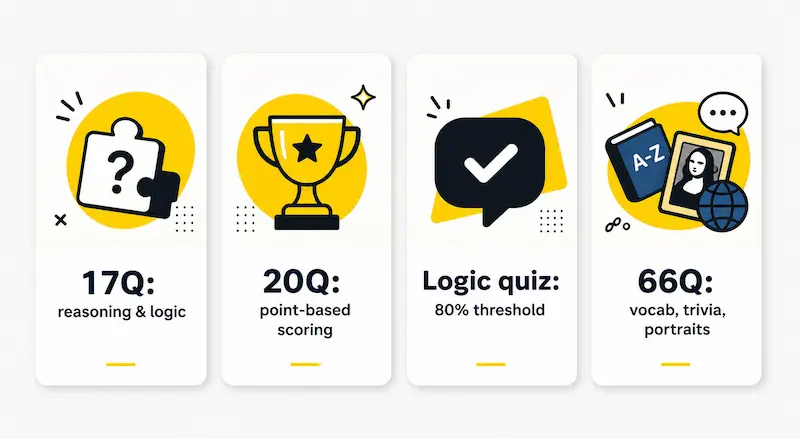
Search "BuzzFeed IQ test" and you won't land on a single quiz — BuzzFeed has run the format repeatedly under different titles and question counts. Current and past versions include a 17-question quiz promising to reveal "how smart you actually are," a separate 20-question version that adds and subtracts points per answer, an 80%-threshold logic quiz, and a 66-question version folding in vocabulary, spelling, movie trivia, and recognizing historical figures from portraits. These aren't variations on one validated instrument — they're separate, independently written entertainment quizzes that happen to share a genre label.
BuzzFeed's own disclaimer, in its own words
This is the detail that separates this piece from most "is the BuzzFeed IQ test accurate" content: BuzzFeed doesn't just implicitly treat these as entertainment — on at least one of its IQ quizzes, the author states it outright in an editor's note attached to the piece, telling readers directly that the quiz doesn't determine real intelligence and that any result should be understood as entirely inaccurate, specifically so nobody feels bad about a disappointing score. That's a direct, on-the-record acknowledgment from the publisher itself that the "IQ" in the title is a hook, not a claim.
How the scoring mechanics work
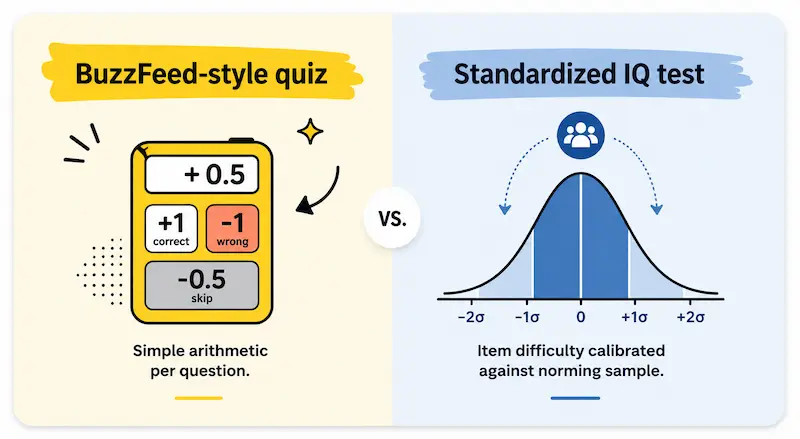
At least one BuzzFeed IQ quiz format uses a distinctive point system: correct answers add points, wrong answers subtract points, and skipping a question subtracts a smaller penalty than a wrong answer — explicitly designed to discourage random guessing across every option ("Christmas-treeing" the quiz, as the author puts it) without requiring the reader to leave an email address to see a result. That's a reasonable design choice for a fun, shareable web quiz. It's nothing like how a real IQ test is scored, where item difficulty is calibrated in advance against a standardization sample rather than tallied point-by-point after the fact.
Why people trust the score anyway, disclaimer and all
This is worth addressing directly, because the disclaimer alone doesn't fully explain the behavior around these quizzes. Reader comments on BuzzFeed's own IQ quizzes show people debating ambiguous questions, comparing scores, and reacting to results ("You have a genius-level IQ!", "I bet you also got a perfect score on your SATs") with genuine emotional investment — celebration, defensiveness, or self-deprecation — even directly beneath a note saying the results don't mean anything. The mechanism isn't complicated: the quiz borrows every surface signal of a real test — a numeric score, comparative language like "higher than 99% of people who took this quiz," an authoritative-sounding result card — while quietly dropping everything that makes those signals trustworthy in an actual instrument: a validated item bank, a real comparison population, controlled administration. The label "IQ" itself does a lot of work here, because it arrives pre-loaded with real-world credibility from an entirely different context. A reader skimming past a disclaimer and landing on a number and a compliment is responding to the number and the compliment, not the caveat above them — which is exactly the dynamic that makes this format effective as shareable entertainment, and exactly why it's worth pointing out plainly rather than assuming it's obvious.
What this means for the "IQ test" label generally
The BuzzFeed case is a clean, well-documented example of a broader pattern worth watching for elsewhere: any quiz using "IQ test" as a headline without publishing item validity, a real comparison population, or a stated margin of error is using the phrase for its credibility, not its meaning. BuzzFeed's own disclaimer is unusually candid — most quizzes using the same format don't say it out loud at all.
If you actually want a real number
If the underlying interest here is genuine curiosity about cognitive ability rather than a shareable result card, that's worth pursuing through an actual measurement. A few starting points: what an IQ score is actually built to measure, how those scores map onto a real distribution, and whether a free online test can get close to a real one — none of which will tell you which "Friends" character you are, but all of which are built around an actual construct rather than a shareable headline.
this is not a cognitive or diagnostic assessment
BuzzFeed's IQ quizzes are entertainment content, by the publisher's own stated framing. The evidence above points to one consistent conclusion: a number produced by an unvalidated quiz, however confidently it's presented, reflects that quiz's design, not the reader's cognitive ability.
Sources
- BuzzFeed — "This 17-Question IQ Test Will Reveal How Smart You Actually Are." https://www.buzzfeed.com/spenceralthouse/best-iq-test-online
- BuzzFeed — "This 17-Question IQ Test Will Reveal How Smart You Really Are" (includes author's accuracy disclaimer and reader comments). https://www.buzzfeed.com/spenceralthouse/online-iq-test
- BuzzFeed — "I'm Not A Doctor, But I'll Estimate Your IQ With This 20-Question Quiz" (point-based scoring mechanic). https://www.buzzfeed.com/audreyworboys/this-quiz-will-estimate-your-iq
- BuzzFeed — "This 66-Question IQ Test Will Reveal How Smart You Actually Are." https://www.buzzfeed.com/evelinamedina/iq-test
Frequently asked questions
Is the BuzzFeed IQ test accurate?+
No — and BuzzFeed says so directly. At least one of its own IQ quizzes includes an editorial note stating the results are entirely inaccurate and don't determine real intelligence.
How many BuzzFeed IQ tests are there?+
Several, published separately over the years — versions range from a 17-question quiz to a 66-question one covering logic, vocabulary, and trivia, with no single standardized version.
Does BuzzFeed's IQ quiz use real IQ scoring?+
No. At least one version uses a simple points-added, points-subtracted system per answer, which is a game-design choice, not a calibrated psychometric scoring method.
If BuzzFeed says its own quiz isn't accurate, why do people still take the score seriously?+
The quiz borrows the surface language of real testing — a number, comparative percentiles, a "genius" label — while skipping the validation behind it, and that framing tends to land emotionally even when a disclaimer is right there on the page.
If BuzzFeed's IQ test isn't real, where can I take an actual one?+
Any standardized test measuring reasoning, working memory, and processing speed under controlled conditions — a fundamentally different format from a shareable entertainment quiz.
Find out your IQ
Take the free IQ test and get your score, percentile, and a full cognitive breakdown in about 12 minutes.
Start Free Test