International IQ Test: What It Is, and How Its Own Data Holds Up
- Written by
- IQCognify Editorial Team
- Reviewed for accuracy
- IQCognify Research Review Process
- Last updated
- Reading time
- 5 min
Quick answer
International IQ Test" is both a generic search phrase and the name of a specific product, international-iq-test.com, online since 2018, with a claimed 16 million-plus completions and two self-published technical reports — a standardization study (N = 66,032 across 2020–2022) and a g-factor report (N = 50,000 per year, 2024–2025). That's genuinely more transparent than most free tests. But the site's own technical report is careful to call its g-figure "internal structural validity" — it's the test's own g-estimate, extracted from the same 40 answers, correlated against the test's own final score from those same answers — not a correlation against an outside instrument. That careful framing doesn't survive onto the site's simpler FAQ page, which states more confidently that this "supports the idea that the test is measuring cognitive ability." Complicating things further: at least one other site (RevisionTown) uses nearly identical "international IQ test" branding with far vaguer, unsubstantiated claims and no comparable published data — worth knowing which one you're actually looking at.
What the International IQ Test Actually Is
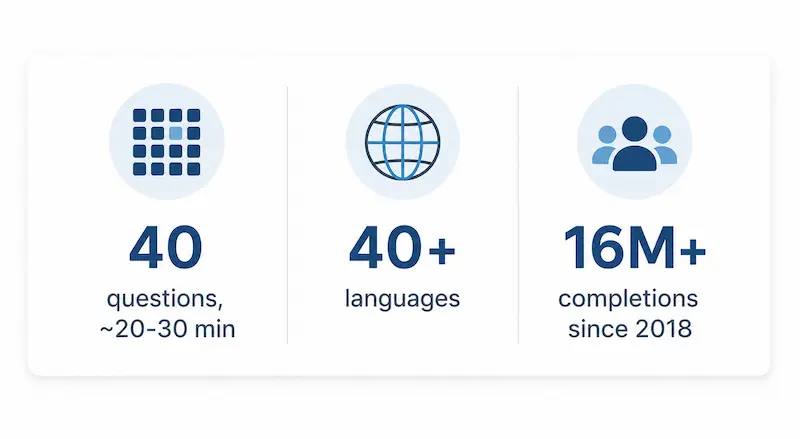
Beyond being a generic search phrase, "International IQ Test" is the actual name of a specific product: international-iq-test.com, which states it has been online since 2018 and describes itself as the first test to use that exact name — a claim worth flagging as self-asserted rather than independently confirmed, since no outside registry tracks "first use" of a generic phrase like this. The test is a 40-question battery inspired by Raven's Progressive Matrices, the nonverbal pattern-completion format developed by psychologist John Carlyle Raven in 1936: each question shows a visual pattern with a missing piece, and the test-taker selects which option completes it. That format is deliberately language-independent, offered in over 40 languages, and takes roughly 20–30 minutes.
What the standardization report actually shows
The site publishes a dedicated report, "Standardization and Calibration of the International IQ Test," using an effective sample of 66,032 results across 2020–2022, after anti-bot and duplicate-response filtering:
| Year | Mean IQ | Standard deviation |
|---|---|---|
| 2020 | ≈100.86 | ≈15.12 |
| 2021 | ≈99.75 | ≈15.15 |
| 2022 | ≈99.82 | ≈15.49 |
Those figures land close to the textbook IQ scale across three separate years — a real, checkable, self-reported claim, and more rigorous than most free tests disclose. A separate country-ranking page indicates the annual dataset is substantial on its own: the 2026 ranking edition alone drew on results from an estimated 1.2 million test-takers in 2025.
Where the "0.94 g-loading" claim actually comes from — in their own words
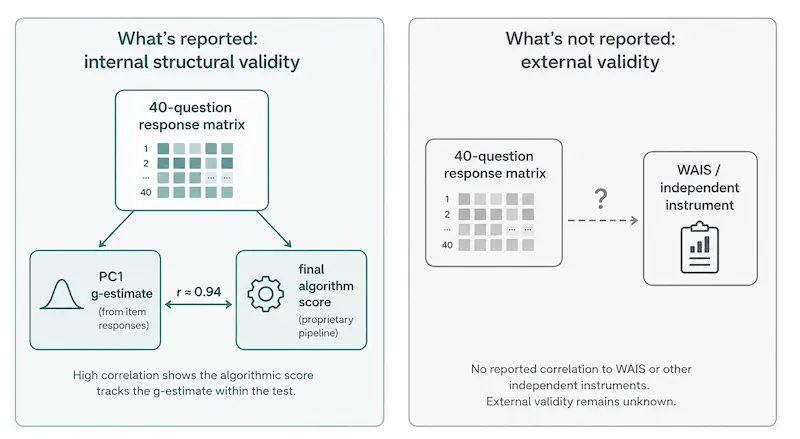
This is the part worth reading carefully. The site's dedicated technical report, titled "Internal g-Loading of the International IQ Test," is explicit about its own method: g is estimated by extracting the first principal component (PC1) from the same 40-item response matrix, and the reported figure is the correlation between that PC1-derived g-estimate and the final score the test's own algorithm produces — from those same 40 answers. The report itself frames this correctly, calling it a measure of "internal structural validity." That's an important, and fair, technical distinction the site draws itself: internal structural validity checks whether a test's own scoring is internally coherent with its own item structure. It's a different, and generally weaker, form of evidence than external (or criterion) validity — correlating a score against an independent outside measure, like a supervised WAIS administration or another established instrument. The site's report doesn't claim otherwise. What's worth flagging is that this careful framing doesn't fully carry through to the plainer summary on the site's main FAQ page, which states the finding "supports the idea that the test is measuring cognitive ability" without repeating the "internal" qualifier — a gap between the technical report's own honesty and the simplified consumer-facing summary of it.
The copycat problem: not every "international IQ test" is the same product
This is worth naming directly, because it's a genuine source of confusion for this exact search term. At least one other site, RevisionTown, offers what it calls an "international IQ test" using very similar language to the original — "official-grade," "scientifically normed," "validated against standard psychometric models" — but without publishing anything resembling the original's standardization report, sample sizes, or methodology papers. It describes its scoring formula in general statistical terms and asserts it is "not a viral gimmick or lead-generation funnel," but offers no equivalent to the two dedicated technical reports the original site publishes. That's not necessarily evidence of bad faith — but it is a clear, checkable example of the same pattern worth watching for across this entire category: confident methodology-sounding language is not the same as published methodology, and a generic product name doesn't guarantee a shared standard between two similarly named tests.
What this means in practice
Relative to most free tests, international-iq-test.com publishing any dedicated technical reports at all — with real sample sizes, multi-year figures, and an accurate technical label on its own validity claim — is a genuine point in its favor, reflected in its broadly positive Trustpilot rating (4.4 out of 5 across roughly 2,850 reviews at the time of writing). But it's worth holding two things at once: the standardization data is solid, disclosed evidence that scores land on a proper bell curve, while the g-factor claim, read carefully in its own technical framing, is internal consistency evidence rather than proof of external validity — a real and useful distinction the site's own report draws, even if its plainer marketing doesn't always repeat it. And structurally, the test itself states directly that it measures one specific ability — nonverbal, abstract pattern reasoning via Raven-style matrices — not every facet of intelligence, and that it isn't diagnostic and doesn't replace an in-person psychological evaluation.
This is not a diagnostic or clinical tool
The International IQ Test's own materials state plainly that it isn't diagnostic and doesn't replace an in-person psychological evaluation. Treat any score, however well-documented the methodology, as an informative estimate of one type of reasoning ability — not a clinical measurement, and be aware that similarly branded competitor sites may not share the same level of disclosed rigor.
Sources
- International IQ Test — homepage and general FAQ. https://international-iq-test.com/
- International IQ Test — "How Reliable Is the International IQ Test?" (standardization and g-factor summary). https://international-iq-test.com/en/test/reliability
- International IQ Test — "Standardization and Calibration of the International IQ Test" (full technical report). https://international-iq-test.com/en/test/standardization
Frequently asked questions
What is the International IQ Test?+
Most often, a free, 40-question, Raven's Progressive Matrices-inspired test at international-iq-test.com, online since 2018, with a claimed 16 million-plus completions — though other sites have adopted similar generic branding without the same published methodology.
Is the International IQ Test's methodology actually published?+
Yes — international-iq-test.com publishes a standardization report and a separate g-factor report, both self-authored, with real sample sizes and multi-year data, though not independently peer-reviewed.
What does the "0.94 g-loading" figure on the International IQ Test actually mean?+
By the site's own technical report, it's a measure of internal structural validity — the test's own g-estimate (via PC1 extraction) correlated against its own final score, both from the same 40 answers — not a correlation against an independent instrument like the WAIS.
Are all "international IQ test" websites the same?+
No. At least one other site uses very similar branding and marketing language without publishing comparable sample sizes or methodology reports — worth checking whether a site actually discloses its data before trusting confident-sounding claims.
Does the International IQ Test replace a real psychological evaluation?+
No. The site states directly that it isn't diagnostic and doesn't replace an in-person assessment by a qualified professional.
What is the maximum score on the International IQ Test?+
142, according to international-iq-test.com's own FAQ.
Find out your IQ
Take the free IQ test and get your score, percentile, and a full cognitive breakdown in about 12 minutes.
Start Free Test