
Dog IQ Test: What Stanley Coren's Ranking Actually Measures
- Written by
- IQCognify Editorial Team
- Reviewed for accuracy
- IQCognify Research Review Process
- Last updated
- Reading time
- 5 min
Quick answer
There's no standardized "IQ test for dogs" the way there is for humans. What "dog IQ test" almost always refers to is psychologist Stanley Coren's 1994 book The Intelligence of Dogs, which ranked over 130 breeds using a survey of roughly 200 obedience judges from the American Kennel Club and Canadian Kennel Club — rating how many repetitions a breed typically needs to learn a command, and how reliably it obeys on the first try. That's a real measurement of one specific thing: working and obedience intelligence — which Coren himself distinguished from two other categories, instinctive and adaptive intelligence, that the famous ranking doesn't cover. More recent peer-reviewed research goes further, finding evidence that dog cognition has a structure surprisingly similar to human intelligence testing: distinct cognitive domains, plus something resembling a general cognitive factor.
What "Dog IQ Test" Actually Refers To
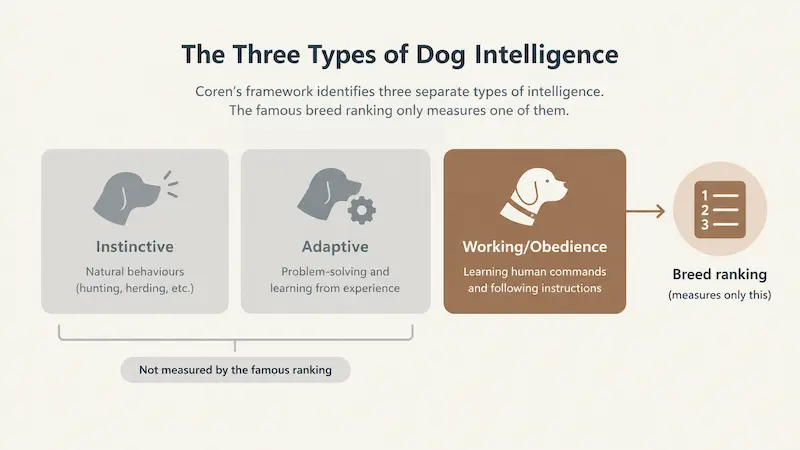
The term almost universally traces back to one source: Stanley Coren, a professor of psychology at the University of British Columbia, and his 1994 book The Intelligence of Dogs. Coren surveyed roughly 200 professional obedience judges affiliated with major kennel clubs, asking them to rate breeds on two specific criteria: how many repetitions a breed typically needs to learn a new command, and what percentage of the time it obeys a known command on the first try. Only breeds with responses from at least 100 judges made the final list, which ranks somewhere between 131 and 138 breeds depending on the edition — a minor inconsistency worth noting since even secondary sources disagree on the exact count. Coren's own framework distinguishes three types of intelligence: instinctive (what a breed was bred to do — herding, retrieving, tracking), adaptive (independent problem-solving and learning from experience), and working/obedience (responsiveness to human training — the only category his famous ranking actually measures). The top of that list — Border Collie, Poodle, German Shepherd, Golden Retriever, Doberman Pinscher — reflects breeds with a long history of close human collaboration, which is exactly what the obedience metric rewards.
Where the Ranking Runs Into Real Limits
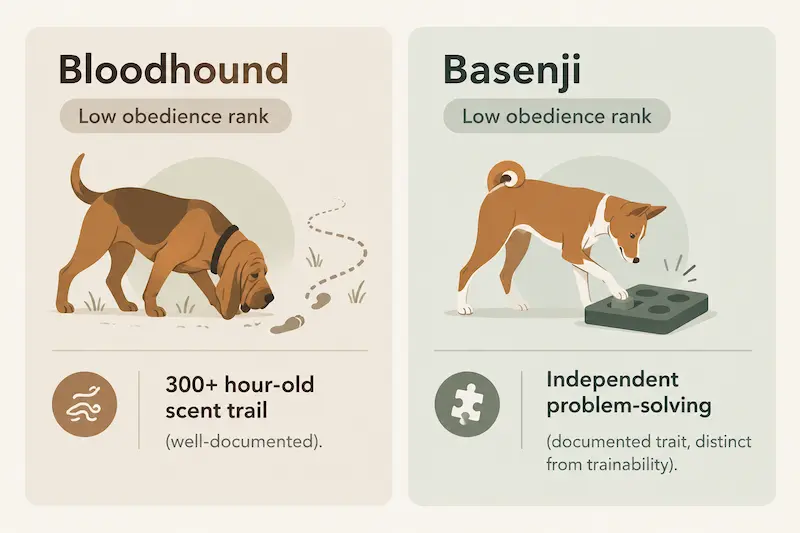
This is worth stating plainly: using obedience-trial performance as a proxy for overall intelligence has a genuine, well-documented blind spot. The clearest example is the Bloodhound, which sits in the lower half of Coren's obedience list but can track a scent trail more than 300 hours old — a figure independently confirmed across veterinary, wildlife-biology, and law-enforcement sources, not a single unverified claim. That's a serious cognitive and sensory feat the obedience metric was never built to capture. The Basenji is a genuinely interesting related case, though it's worth being precise about what's actually documented rather than overstating it. Basenjis consistently rank low on trainability and obedience metrics — multiple independent sources describe them as notoriously difficult to train, having functioned as self-reliant, semi-independent hunting dogs for thousands of years. At the same time, a modern cognitive-assessment platform built on peer-reviewed dog-cognition research separately characterizes Basenjis as showing strong "independent problem-solving" tendencies in structured assessments — a genuinely different trait from obedience, even if it isn't accurate to claim they "rival" the top obedience-ranked breeds on any single measured task. The honest version: low trainability and independent problem-solving aren't the same axis, and treating a breed's obedience rank as its overall intelligence score conflates the two.
What Modern Research Adds — A Real "Canine g Factor"
This is where the topic gets genuinely more interesting than the 1994 ranking alone. A 2022 study published in Scientific Reports by University of Helsinki researchers tested breed differences in social cognition, inhibitory control, and spatial problem-solving directly, using controlled experimental tasks rather than judge surveys — a meaningfully more rigorous method than obedience-trial impressions. Separately, researchers analyzing a battery of seven cognitive tasks across 129 pet dogs found evidence for a hierarchical structure: both distinct cognitive domains and an overarching general cognitive factor, sometimes called a "canine g," which the researchers validated against traits like exploration tendency and neophilia — traits conceptually related to Openness, a personality dimension with a known correlation to human IQ. That's a striking parallel to the g-factor concept in human intelligence research: dogs, like people, may have both specialized abilities and something resembling a general cognitive factor running across them — a genuinely more sophisticated picture than a single obedience-based breed ranking from 1994 can offer.
If You Actually Want to Test Your Own Dog
Rather than relying on informal quizzes, a currently active platform called Dognition — associated with canine-cognition researcher Dr. Brian Hare — offers a structured assessment measuring five distinct dimensions: Empathy, Communication, Cunning, Memory, and Reasoning, built on published dog-cognition research rather than a single obedience metric. That's a meaningfully different approach from Coren's breed-level survey: it assesses an individual dog directly, across multiple distinct dimensions, rather than reporting a single averaged score for an entire breed. A well-socialized dog from a breed near the bottom of Coren's obedience list can easily show strong results in several of these dimensions — the same individual-variation point that applies to any group-level average, including human occupational or demographic figures.
This is not a standardized psychometric measurement
Nothing described here is a validated psychological instrument in the way a human IQ test is. Breed rankings and even structured platforms like Dognition describe tendencies and patterns from aggregated data, not certified individual measurement — useful for understanding a dog's general disposition, not a clinical or diagnostic claim about any specific animal.
Sources
- Coren, S. (1994, revised 2006) — The Intelligence of Dogs, summarized via Pets4Homes: "Stanley Coren's Guide to Dog Intelligence & Breed Rankings." https://www.pets4homes.co.uk/pet-advice/stanley-coren-and-the-intelligence-of-dogs.html
- Letsgetpet — "Stanley Coren's dog intelligence ranking" (full ranked list by tier). https://www.letsgetpet.com/dogs/all-about-dogs/stanley-corens-dog-intelligence-ranking/
- PBS Nature — "The Bloodhound's Amazing Sense of Smell" (300-hour scent-trail tracking, original documented source). https://www.pbs.org/wnet/nature/underdogs-the-bloodhounds-amazing-sense-of-smell/350/
- Scientific Reports (Nature) — Salomons et al. (2022), "Breed differences in social cognition, inhibitory control, and spatial problem-solving ability in the domestic dog." https://www.nature.com/articles/s41598-022-26991-5
- bioRxiv — "The hierarchical structure of canine cognition: two domains and a general cognitive factor" (canine g factor research). https://www.biorxiv.org/content/10.1101/2023.02.07.525704.full.pdf
- Dognition — "The Smartest Dog Breed? Science Says the Question Is Wrong" (five-dimension individual cognitive assessment). https://dognition.com/smartest-dog-breeds
- DogTime — "Basenji Dog Breed Information & Characteristics" (independent temperament, trainability distinct from intelligence). https://dogtime.com/dog-breeds/basenji
Frequently asked questions
Is there a real IQ test for dogs?+
Not in the standardized sense used for humans. The commonly cited "dog IQ" ranking is Stanley Coren's 1994 obedience-judge survey measuring trainability, not a validated general intelligence test.
What breed ranks as the smartest dog according to the famous ranking?+
The Border Collie, followed by the Poodle and German Shepherd, based on Coren's survey of obedience judges rating command-learning speed and first-try obedience — a measure of trainability specifically, not overall cognition.
Does the dog intelligence ranking measure real intelligence or just obedience?+
Primarily obedience and trainability. Coren's own framework separately identifies instinctive intelligence (breed-specific natural abilities) and adaptive intelligence (independent problem-solving), neither of which the famous ranking covers.
Why do some low-ranked breeds do impressive things, like tracking scents for miles?+
Because the obedience ranking measures one narrow trait. The Bloodhound's well-documented ability to track a scent trail over 300 hours old is an instinctive and sensory capability entirely outside what an obedience-training metric captures.
Is there real scientific research on dog intelligence beyond Coren's 1994 ranking?+
Yes — a 2022 peer-reviewed study and separate cognitive-structure research have found evidence that dog cognition includes both distinct domains and an overarching general factor, a more sophisticated picture than a single breed-obedience ranking.
Can I test my own dog's intelligence rather than relying on its breed's ranking?+
Yes — platforms like Dognition offer a structured, multi-dimensional cognitive assessment for individual dogs, built on published research, as a more current alternative to informal online "dog IQ" quizzes.
Find out your IQ
Take the free IQ test and get your score, percentile, and a full cognitive breakdown in about 12 minutes.
Start Free Test