
IQ Test Reddit: What r/cognitiveTesting Actually Built, and How Good It Is
- Written by
- IQCognify Editorial Team
- Reviewed for accuracy
- IQCognify Research Review Process
- Last updated
- Reading time
- 5 min
Quick answer
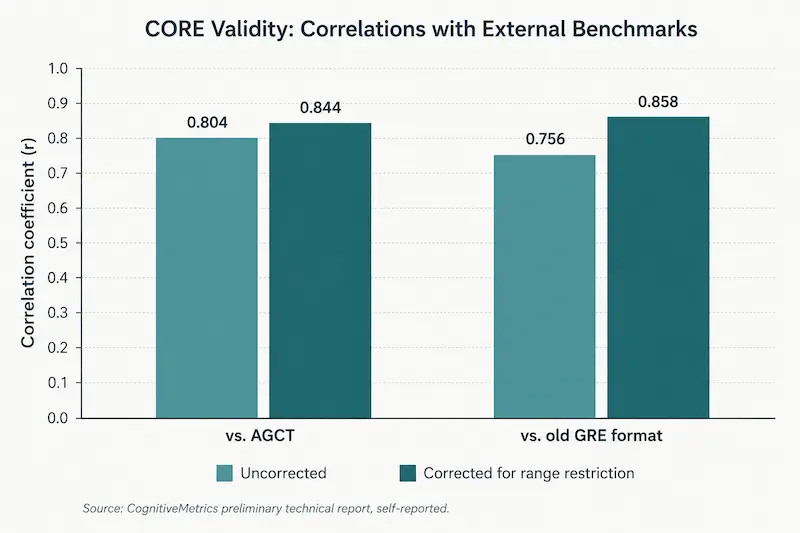
The community most people mean when they search "IQ test Reddit" is r/cognitiveTesting, and its most notable output is a free test the community built itself, currently called CORE (Comprehensive Online Reasoning Exam), hosted on CognitiveMetrics. CORE replaced an earlier community test called CAIT and is built on the Cattell-Horn-Carroll (CHC) theory of intelligence, the leading framework in contemporary psychometrics. Unlike most free tests, CORE has a published preliminary technical report (N = 4,723) reporting correlations with other cognitive measures — r = 0.804 with the Army General Classification Test and r = 0.756 with an older, now-discontinued GRE format, both before correction — along with factor-analysis statistics that CognitiveMetrics presents alongside published figures for the WAIS-V. It's worth being precise about what that means: these are CognitiveMetrics' own self-reported findings, not an independent audit, and the report itself names its biggest limitation — a self-selected sample skewing toward people already interested in cognitive testing.
IQ Test Reddit: Why CORE Gets Recommended So Often
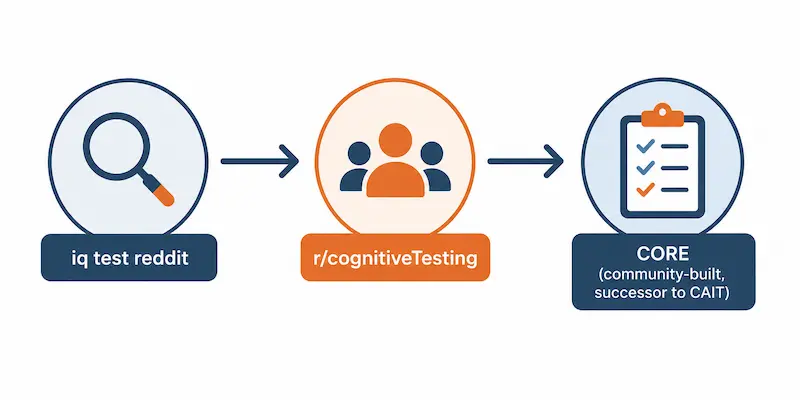
"IQ test Reddit" isn't really about scattered comment threads — it converges heavily on one specific, active community: r/cognitiveTesting, a subreddit dedicated to cognitive testing discussion. What distinguishes it from a typical review-aggregator site is that its most visible recommendation isn't a link to an existing test — it's a test the community built and continues to develop itself. That test is currently CORE, which describes itself as developed by prominent members of the r/cognitiveTesting community. It replaced an earlier project, CAIT (Comprehensive Adult Intelligence Test, built by Reddit user u/EqusB and modeled on the WAIS-IV), which CognitiveMetrics now presents as CORE's predecessor rather than an actively recommended current test. A note on how to read everything that follows: the validity data below comes from CognitiveMetrics itself, describing its own test. That's genuinely more transparent than the vast majority of free IQ tests, which publish no methodology at all — but it's self-reported, not independently peer-reviewed or audited by a third party. Treat the numbers as "here's what the test's own developers found," not as an outside seal of approval.
What CORE actually measures
CORE is built on the Cattell-Horn-Carroll (CHC) theory of intelligence, the dominant framework in contemporary psychometrics, and is structured around six indices: Verbal Comprehension, Fluid Reasoning, Visual Spatial, Quantitative Reasoning, Working Memory, and Processing Speed. CognitiveMetrics offers three testing tiers depending on how much time someone wants to spend:
| Battery | Time | Subtests included |
|---|---|---|
| Abbreviated | ~30 minutes | Analogies, Figure Weights, Digit Span |
| Optimized | ~2 hours | Analogies, Matrix Reasoning, Figure Weights, Graph Mapping, Visual Puzzles, Spatial Awareness, Quantitative Knowledge, Digit Span |
| Full | ~3 hours | Every subtest across all six indices |
That range of options — from a quick screen to a genuinely lengthy full battery — is a meaningfully different structure than the single 10-to-15-minute quiz most free "IQ test" sites offer.
What the published validity data actually shows
This is the part worth taking seriously, because it's rare for a free test to publish it at all — while keeping in mind this is the developers reporting on their own test. CognitiveMetrics released a preliminary technical report (version 0.2, dated December 2025) analyzing data from 4,723 participants. A few of the concrete findings:
- Convergent validity: CORE's Full Scale IQ correlated with the Army General Classification Test (AGCT) at r = 0.804 (rising to r = 0.844 after correcting for indirect range restriction), and with an older GRE composite score at r = 0.756 (rising to r = 0.858 after the same correction). Worth knowing: this refers to the old GRE scoring format used before the test was revised in 2011, which CognitiveMetrics offers as one of its own comparison instruments — not the current GRE format test-takers encounter today. It's a useful internal benchmark within their platform, but not a comparison to a currently administered, independently normed exam.
- Mean score differences: Compared against the AGCT, CORE scores differed by an average of just -2.35 points; against the GRE composite, -0.73 points — both described in the report as well within normal measurement error.
- Structural fit: CognitiveMetrics reports CORE's hierarchical factor model fit statistics (CFI = 0.976, RMSEA = 0.018) directly alongside published figures for the WAIS-V (CFI = 0.97, RMSEA = 0.04) and Stanford-Binet-V (CFI = 0.94, RMSEA = 0.076). In plain terms, CFI (Comparative Fit Index) and RMSEA (Root Mean Square Error of Approximation) are statistics used to judge how well a proposed structure — in this case, CORE's six-index model — matches the patterns actually observed in the data; CFI closer to 1.0 and RMSEA closer to 0 both indicate a better-fitting model. CognitiveMetrics presents its own CFI and RMSEA as being in a similar range to those published for the WAIS-V's technical manual — that's a real, checkable statistical claim, but it describes internal model fit, not proof that CORE measures intelligence as accurately as a supervised, clinically administered WAIS session does in practice.
Where the same report flags its own limits
CognitiveMetrics doesn't just present favorable numbers — its report states its central limitation directly, without prompting: because the test is free and publicly available, and most participants likely encounter it through r/cognitiveTesting, the sample is self-selected, with a pre-existing interest in cognitive testing. That shows up in the data itself — the reported sample's mean Full Scale IQ was 123.49, well above the general-population average of 100, which the report explicitly attributes to this selection effect rather than treating the figure as representative of the wider public. That's a meaningfully more transparent disclosure than most free online tests offer. It's also a real reason to treat any individual CORE score, and the validity figures behind it, as one test-maker's own internal analysis rather than an independently confirmed, general-population result.
What this means if you're deciding whether to trust a score
If you're weighing a Reddit-community test like CORE against a full professional battery, the honest framing is that CORE's published methodology — a real technical report, stated correlations against other measures, and directly acknowledged sampling limitations — represents a genuinely unusual level of self-published transparency for a free test. It is not the same as independent, third-party validation, and it is not equivalent to a supervised psychometric evaluation administered by a licensed professional on a representative norming sample. CognitiveMetrics itself describes CORE as not intended for clinical or diagnostic use.
This is not a diagnostic or clinical tool
No free or community-built test, including CORE, substitutes for assessment by a qualified psychologist. Treat any score from an unsupervised, self-administered test as an informative estimate, not a diagnosis.
Sources
- CognitiveMetrics — "CORE: Comprehensive Online Reasoning Exam" overview and test structure. https://cognitivemetrics.com/test/CORE
- CognitiveMetrics — "CORE Validity: Preliminary Technical Report" (v0.2, December 2025). https://cognitivemetrics.com/test/CORE/validity
- CognitiveMetrics — "CAIT: Comprehensive Adult Intelligence Test" (predecessor project page). https://cognitivemetrics.com/test/CAIT
- r/cognitiveTesting — official community. https://www.reddit.com/r/cognitiveTesting/
Frequently asked questions
What is the IQ test Reddit users recommend most often?+
Currently, CORE (Comprehensive Online Reasoning Exam), a free test built by members of the r/cognitiveTesting community and hosted on CognitiveMetrics. It replaced an earlier community project called CAIT.
Is r/cognitiveTesting a legitimate source for IQ test recommendations?+
It's an active community focused specifically on cognitive testing, and it's the origin of CORE, which has published real validity data — a level of transparency uncommon for free online tests, though the data is self-reported by the test's own developers, and individual comment recommendations still vary in quality like any forum.
How accurate is the CORE IQ test?+
According to CognitiveMetrics' own preliminary technical report, CORE correlates at r = 0.804–0.844 with the Army General Classification Test and r = 0.756–0.858 with an older GRE format, with factor-analysis fit statistics reported in a similar range to the WAIS-V's — figures that come from the test's own developers rather than an independent audit.
What happened to CAIT, the old Reddit IQ test?+
CAIT, built by Reddit user u/EqusB and modeled on the WAIS-IV, has been replaced by CORE, a more comprehensive successor built by the wider r/cognitiveTesting community.
Can a free, community-built test like CORE replace a real IQ assessment?+
No. Even with published, self-reported validity data, CORE lacks independent third-party validation, supervised administration, and general-population norming, and CognitiveMetrics states it isn't intended as a clinical or diagnostic tool.
Find out your IQ
Take the free IQ test and get your score, percentile, and a full cognitive breakdown in about 12 minutes.
Start Free Test