
Montreal Cognitive Assessment (MoCA): What It Tests, and What It Doesn't
- Written by
- IQCognify Editorial Team
- Reviewed for accuracy
- IQCognify Research Review Process
- Last updated
- Reading time
- 7 min
Quick answer
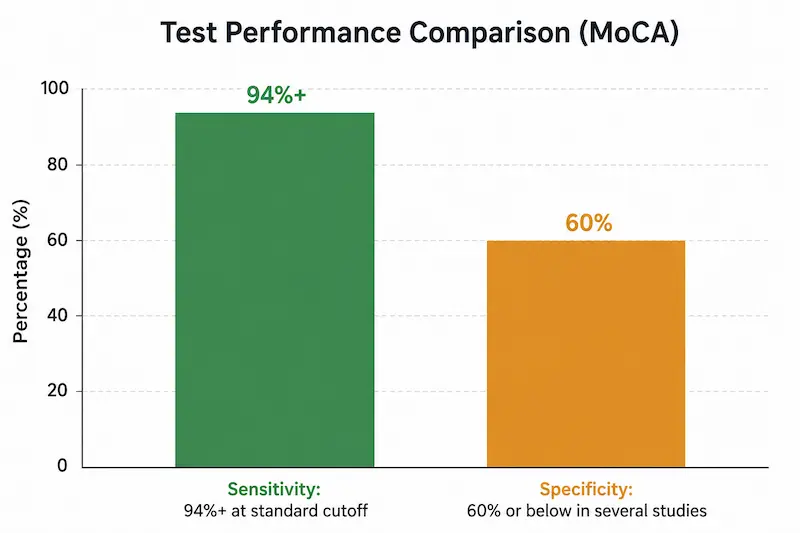
The Montreal Cognitive Assessment (MoCA) is a 30-point, 10-to-15-minute clinical screening tool developed by Dr. Ziad Nasreddine and colleagues, published in 2005, to catch mild cognitive impairment (MCI) and early dementia that an older test, the MMSE, was missing. It is not an IQ test — it doesn't measure reasoning ability across the general population, it screens for signs of decline against a single cutoff (26 out of 30). That sensitivity is also its biggest limitation: a Cochrane systematic review found the MoCA correctly identifies over 94% of true dementia cases at the standard threshold, but specificity drops to 60% or below in several of the reviewed studies — meaning a low score is a reason to get a proper clinical evaluation, not a diagnosis on its own.
What the MoCA actually is
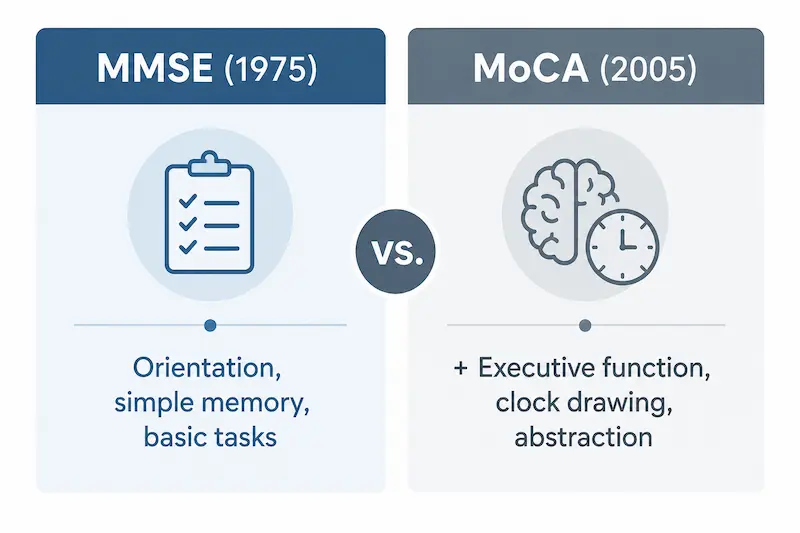
The Montreal Cognitive Assessment was developed by neurologist Dr. Ziad Nasreddine and colleagues, first used clinically in the years leading up to its formal 2005 publication in the Journal of the American Geriatrics Society, as a response to a specific, well-documented gap: the older MMSE was missing a substantial share of mild cognitive impairment cases that more thorough testing caught. The MMSE, developed in 1975 by Marshal and Susan Folstein, leans heavily on orientation and simple memory tasks — tasks that people in the early stages of decline can often still perform well, producing a "ceiling effect" where too many people with real, subtle impairment still score in the normal range. The MoCA closes that gap with harder, more targeted tasks: a Trail Making Test variant for executive function, a clock-drawing task for visuospatial ability, and abstraction questions that ask a patient to explain how two seemingly unrelated things (a train and a bicycle, for instance) are conceptually alike. Those are exactly the kinds of tasks that deteriorate early in conditions like Alzheimer's and Parkinson's, which is why the MoCA catches problems the MMSE's simpler format can miss.
The eight domains, and how scoring works
| Domain | Points | What it tests |
|---|---|---|
| Visuospatial / Executive | 5 | Trail-making variant, cube copy, clock drawing |
| Naming | 3 | Identifying pictured animals |
| Attention | 6 | Digit span, vigilance task, serial subtraction |
| Language | 3 | Sentence repetition, verbal fluency |
| Abstraction | 2 | Explaining conceptual similarity between two items |
| Delayed Recall | 5 | Recalling five words after a delay, unprompted |
| Orientation | 6 | Date, place, and situational awareness |
The total is scored out of 30, with a standard education adjustment: anyone with fewer than 12 years of formal education gets an extra point added, since lower educational attainment is independently associated with lower scores on tasks like this regardless of actual cognitive status — the original validation study built this correction in directly. A score of 26 or above is considered normal, though a body of later research, including a 2021 analysis on cutoff optimization, suggests thresholds lower than 26 may actually produce better diagnostic accuracy — an unresolved question the original single-cutoff design doesn't fully settle.
Why the MoCA's biggest strength is also its biggest limitation
This is the part most content on this topic skips. The MoCA's sensitivity — its ability to catch real impairment — is genuinely strong: the original Nasreddine validation study reported detecting roughly 90% of MCI cases and 100% of mild Alzheimer's cases. That's a real clinical advance, and it's why the MoCA has become the more widely used tool in geriatrics, neurology, and post-stroke care since 2005. But a tool tuned to be that sensitive inevitably catches some people who don't actually have the condition. The Cochrane Collaboration's own systematic review of MoCA diagnostic accuracy — which pooled seven qualifying studies across memory clinics, general hospitals, and general-population samples — found that at the standard threshold of 26, sensitivity reached 0.94 or higher in four studies, but specificity in those same studies was 0.60 or below. In plain terms: correctly catching over 94% of real dementia cases came paired with a false-positive rate covering a large share of people who don't actually have the condition. The Cochrane reviewers were direct about the practical implication, noting that the tool can help identify people who need further specialist assessment — not that a low score should be treated as a diagnosis on its own. The reviewers also concluded that the overall evidence base wasn't strong enough to make firm recommendations for MoCA use across every healthcare setting, and specifically flagged that no primary-care studies met their inclusion criteria at all. Separately, in populations outside the original validation group — old-age psychiatry cohorts, for instance — later research found specificity at the standard cutoff dropping to around 73% even in a case-control design, and worse once healthy community controls were compared against a real clinical population rather than a curated comparison group. None of that means the MoCA is a bad tool. It means a single score below 26 is a signal to pursue a proper evaluation, not a standalone diagnosis — a distinction that matters a great deal for anyone who takes an online version and gets an unexpectedly low number.
Why "Montreal Cognitive Assessment test" gets searched so often
Beyond its clinical use, the MoCA entered mainstream awareness after being administered, and publicly discussed, in connection with a U.S. president's cognitive evaluations in 2018 and 2020 — coverage that introduced the test's name to a much wider audience than its usual clinical setting. That's a large part of why the term shows steady, non-clinical search interest: many people searching it are curious what the test actually involves after hearing about it in the news, not necessarily seeking a screening for themselves or a family member. It's worth separating that curiosity from the tool's actual clinical purpose, which is screening in at-risk populations, not a general-public intelligence or fitness benchmark.
How this differs from an IQ test
It's worth being direct about the category difference, since "test" and "score out of 30" invite comparison to an IQ number. IQ tests measure reasoning ability across the general population on a continuous scale — most people score near 100, with a well-defined spread in both directions, captured on a full score chart. The MoCA does something structurally different: it screens for decline against a single clinical cutoff, in populations where impairment is already a realistic possibility. A healthy 30-year-old and a healthy 80-year-old should both score near the top of the MoCA; the test isn't designed to differentiate ability levels the way working memory or processing speed subtests do within a standard IQ battery — it's designed to catch a drop-off from a person's own expected baseline. Confusing the two categories is a common source of unnecessary worry.
If you're taking an online version
Digital, self-administered adaptations of the MoCA exist, but the sensitivity and specificity figures cited throughout the clinical literature come from in-person, clinician-administered testing — a browser-based version carries meaningfully more measurement noise, similar to the gap this site covers between a free online IQ estimate and a full psychometric evaluation. The test is also freely available for clinical and educational use with specific licensing terms set by its developer, which is worth knowing if you're comparing versions found online against what a clinician actually administers.
This is not a diagnostic tool, and this article isn't medical advice
A low score on any version of the MoCA, especially a self-administered online one, is not a diagnosis of dementia or cognitive impairment. If you or someone you know is concerned about cognitive changes, the appropriate next step is an evaluation by a physician or qualified clinician — not a repeated online test or a single number taken at face value.
Sources
- Nasreddine, Z.S., Phillips, N.A., Bédirian, V., et al. (2005) — "The Montreal Cognitive Assessment, MoCA: A Brief Screening Tool For Mild Cognitive Impairment," Journal of the American Geriatrics Society, 53(4): 695–699. https://doi.org/10.1111/j.1532-5415.2005.53221.x
- Davis, D.H.J. et al. (2021) — "Montreal Cognitive Assessment for the detection of dementia," Cochrane Database of Systematic Reviews. https://www.cochranelibrary.com/cdsr/doi/10.1002/14651858.CD010775.pub3/full (plain-language summary: https://www.cochrane.org/evidence/CD010775_montreal-cognitive-assessment-moca-detection-dementia)
- PubMed — "Diagnostic accuracy of the Montreal Cognitive Assessment (MoCA) for cognitive screening in old age psychiatry: Determining cutoff scores in clinical practice." https://pubmed.ncbi.nlm.nih.gov/31650623/
- PMC — "Examining the Validity and Utility of Montreal Cognitive Assessment (MoCA) Domain Scores for early Neurocognitive Disorders." https://pmc.ncbi.nlm.nih.gov/articles/PMC10123003/
- ScienceDirect Topics — "Montreal Cognitive Assessment" overview. https://www.sciencedirect.com/topics/medicine-and-dentistry/montreal-cognitive-assessment
- SimplePractice — "MoCA vs. MMSE: A Comprehensive Guide for Mental Health Clinicians." https://www.simplepractice.com/blog/moca-vs-mmse/
Frequently asked questions
What does the Montreal Cognitive Assessment actually test?+
Eight cognitive domains — visuospatial/executive function, naming, memory, attention, language, abstraction, delayed recall, and orientation — scored on a single 30-point scale.
What is a normal MoCA score?+
26 or above out of 30 is the standard cutoff, with an additional point added for anyone with fewer than 12 years of education, though some later research suggests a lower threshold may be more accurate.
is the MoCA the same as an IQ test?+
No. It's a clinical screening tool for cognitive decline, not a measure of reasoning ability across the general population the way an IQ test is.
How accurate is the MoCA?+
A Cochrane review found sensitivity of 94% or higher at the standard cutoff in several studies, but specificity of 60% or below in the same studies — meaning a meaningful share of cognitively normal people also score below "normal."
Why is the MoCA used instead of the older MMSE?+
The MMSE was found to miss a substantial share of mild cognitive impairment cases that more sensitive testing caught; the MoCA was built specifically to close that gap with harder executive-function, visuospatial, and abstraction tasks.
Can I trust an online MoCA test result?+
Treat it as a rough indicator at best. The validated sensitivity and specificity figures come from in-person, clinician-administered testing, and self-administered digital versions carry more measurement noise.
Find out your IQ
Take the free IQ test and get your score, percentile, and a full cognitive breakdown in about 12 minutes.
Start Free Test