
Neuromyths in Education
- Written by
- IQCognify Editorial Team
- Reviewed for accuracy
- IQCognify Research Review Process
- Last updated
- Reading time
- 5 min
Quick answer
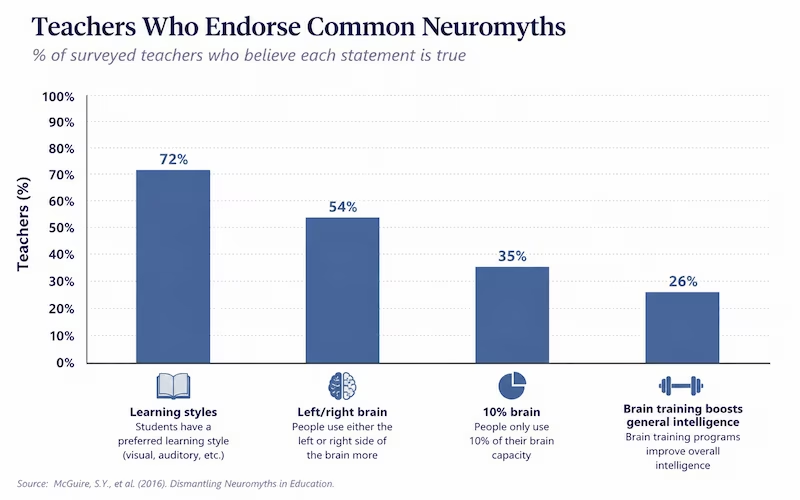
A neuromyth is a false belief about the brain that persists because it sounds scientific and feels intuitive. Surveys of working teachers find large majorities endorse several of them — including the learning-styles myth, believed by over 90% of teachers surveyed, despite having been tested directly and failed.
How widespread they actually are
The foundational measurement comes from Dekker and colleagues, published in Frontiers in Psychology in 2012. They put 32 statements about the brain and learning — 15 of them established myths — to schoolteachers in the United Kingdom and the Netherlands. Teachers endorsed, on average, about half of the myths. Belief was actually higher, not lower, among teachers who were more interested in neuroscience. The single most-endorsed myth was learning styles. Some 93% of the UK teachers and 96% of the Dutch teachers agreed that people learn better when taught in their "preferred learning style." That is not a fringe belief. That is a near-consensus among the professionals in the room — for a claim that fails when it is tested.
Why this belongs on a site about intelligence
Neuromyths and IQ myths run on the same fuel: a real scientific finding, oversimplified into something more useful-sounding than the truth. The multiple intelligences idea and the left-brain/right-brain split are the education-world cousins of the myths that surround intelligence testing, and the same scepticism that protects against overclaimed IQ headlines protects against these.
Learning styles: the myth that has been tested and failed
The learning-styles claim is specific and, unusually for a myth, falsifiable. It says each learner has a preferred channel — visual, auditory, or kinaesthetic — and that matching instruction to that channel improves learning. That prediction can be tested directly: teach the same material to people in their "preferred" style and in a non-preferred style, and see who learns more. When researchers run that test, the matching effect does not appear. Pashler and colleagues' 2008 review in Psychological Science in the Public Interest went further, setting out exactly what a rigorous test of the hypothesis would need to look like — and found that almost no published study met that bar, and the handful that came close found no matching benefit. People do have preferences about how they like to receive information; those preferences do not predict which method actually teaches them better. The belief survives not because the evidence supports it but because it is intuitive, it feels respectful of individual difference, and almost nobody who holds it has ever seen it tested. The honest replacement is duller and more useful: what works depends far more on the material than on the learner's supposed channel. A map is best shown, a poem is best heard, a knot is best practised — for everyone.
Left brain, right brain
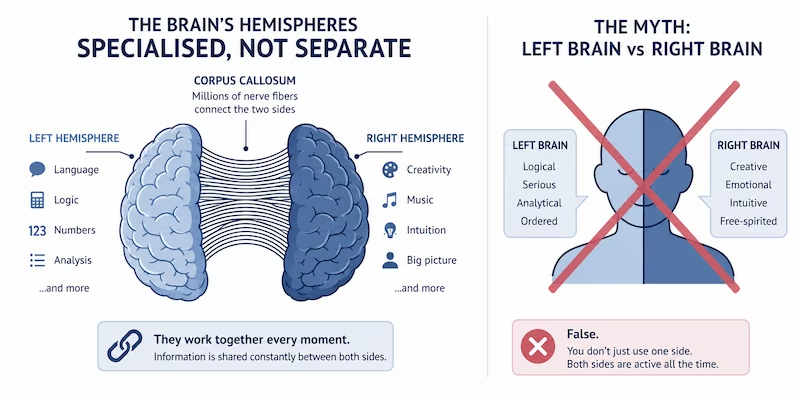
The idea that people are "left-brained" (logical, analytical) or "right-brained" (creative, intuitive) is one of the stickiest neuromyths, and it is a genuine scientific finding stretched past breaking point. The hemispheres are specialised — language leans left for most people, some spatial functions lean right — but they are massively interconnected and work together on essentially everything. What does not exist is the personality split: individuals who "use" one hemisphere more and are therefore analytical or artistic as a result. Nielsen and colleagues tested this directly in 2013, analysing resting-state brain connectivity in over 1,000 people — and found no evidence of individuals favouring a dominant hemisphere as a stable trait. The full story, including how the researcher whose split-brain work launched the popular idea explicitly warned against this exact misreading, is on our dedicated page about left brain vs right brain.
The 10% brain, and other durable favourites
- "We only use 10% of our brains." False. Imaging shows activity across the whole brain over a day, and there is no silent 90% — damage to almost any region has consequences. If most of the brain were idle, strokes would usually be harmless.
- "Brain training makes you smarter overall." Training makes you better at the trained task and things very like it. It does not raise general intelligence — a distinction we cover in do brain-training games work.
- "You're either a maths person or not." Ability is real and varies, but this framing mistakes a distribution for a pair of fixed categories.
- "Listening to Mozart makes children smarter." The original finding was a small, brief effect on one spatial task in adults, and it did not replicate as the sweeping claim it became
Why they are so hard to kill
Neuromyths persist for reasons that have little to do with intelligence or diligence. They are intuitive — they match how learning feels from the inside. They are useful — a teacher who believes in learning styles has a ready framework for handling a diverse class. And they come dressed in real neuroscience vocabulary, which, counter-intuitively, makes them harder to question: a claim that mentions hemispheres or neurons sounds like it has already been checked. The Dekker finding that neuroscience-interested teachers believed more myths captures the trap exactly. Exposure to brain facts, without the training to tell a real inference from a plausible-sounding one, can increase confidence in myths rather than dispel them. This has real classroom consequences beyond wasted effort: Howard-Jones' 2014 review in Nature Reviews Neuroscience notes that resources spent tailoring instruction to "learning styles" or designing curricula around debunked hemisphere theories are resources not spent on interventions with actual evidence behind them. The defence is not more brain trivia; it is the habit of asking what a claim predicts and whether anyone has tested it — the same habit that separates real psychometrics from folklore about IQ.
Sources
- Dekker, S., Lee, N. C., Howard-Jones, P., & Jolles, J. (2012). "Neuromyths in education: Prevalence and predictors of misconceptions among teachers." Frontiers in Psychology, 3, 429. — https://doi.org/10.3389/fpsyg.2012.00429
- Pashler, H., McDaniel, M., Rohrer, D., & Bjork, R. (2008). "Learning styles: Concepts and evidence." Psychological Science in the Public Interest, 9(3), 105–119. — https://doi.org/10.1111/j.1539-6053.2009.01038.x
- Nielsen, J. A., Zielinski, B. A., Ferguson, M. A., Lainhart, J. E., & Anderson, J. S. (2013). "An evaluation of the left-brain vs. right-brain hypothesis with resting state functional connectivity magnetic resonance imaging." PLOS ONE, 8(8), e71275. — https://doi.org/10.1371/journal.pone.0071275
- Howard-Jones, P. A. (2014). "Neuroscience and education: myths and messages." Nature Reviews Neuroscience, 15(12), 817–824. — https://doi.org/10.1038/nrn3817
- Deary, I. J. (2020). Intelligence: A Very Short Introduction (2nd ed.). Oxford University Press.
Frequently asked questions
What is a neuromyth?+
A neuromyth is a false or oversimplified belief about how the brain works, especially in relation to learning. Common examples include learning styles, the idea that people are left- or right-brained, and the claim that we only use 10% of our brains. They persist because they sound scientific and feel intuitive.
Do learning styles work?+
No. The claim that matching teaching to a learner's preferred style (visual, auditory, kinaesthetic) improves learning has been tested directly and fails: the matching effect does not appear. Pashler and colleagues' 2008 review found almost no rigorous study supporting it. People have preferences about how they receive information, but those preferences do not predict which method actually teaches them better.
How many teachers believe neuromyths?+
A lot. In Dekker and colleagues' 2012 survey, teachers endorsed about half of the neuromyths tested. The learning-styles myth was endorsed by 93% of UK teachers and 96% of Dutch teachers. Belief was somewhat higher among teachers more interested in neuroscience, not lower.
Is the left-brain/right-brain personality idea true?+
No. The hemispheres are genuinely specialised — language leans left for most people, for instance — but they are heavily interconnected and cooperate on nearly everything. Nielsen and colleagues' 2013 imaging study of over 1,000 people found no evidence that individuals favour one hemisphere as a stable trait that makes them logical or creative.
Do we really only use 10% of our brains?+
Find out your IQ
Take the free IQ test and get your score, percentile, and a full cognitive breakdown in about 12 minutes.
Start Free Test