
Sex Differences in Intelligence: What the Evidence Shows
- Written by
- IQCognify Editorial Team
- Reviewed for accuracy
- IQCognify Research Review Process
- Last updated
- Reading time
- 4 min
Quick answer
On overall (general) intelligence, average scores between men and women are essentially equal. The genuinely replicated finding is about variability — greater score spread at both extremes in one sex — not a difference in typical ability, and specific-ability differences that exist are modest, run in both directions, and are often trainable.
On overall intelligence, the averages barely differ
Start with the claim people most want answered: is one sex, on average, more intelligent than the other? On general intelligence — the common factor across cognitive tests — the answer from large samples is that any average difference is negligible. Depending on the battery and the sample it comes out at essentially zero, sometimes a point or two in one direction, well within the noise. It is not a difference you could use to predict anything about a person. This is unsurprising once you remember how tests are built. IQ batteries are assembled and normed to measure a general factor, and items that produced large sex gaps have historically been balanced or dropped precisely because they were seen as measuring something other than general ability. But even on the underlying factor, the mean difference is small. The interesting sex difference is not in the average.
The real finding is about spread, not average
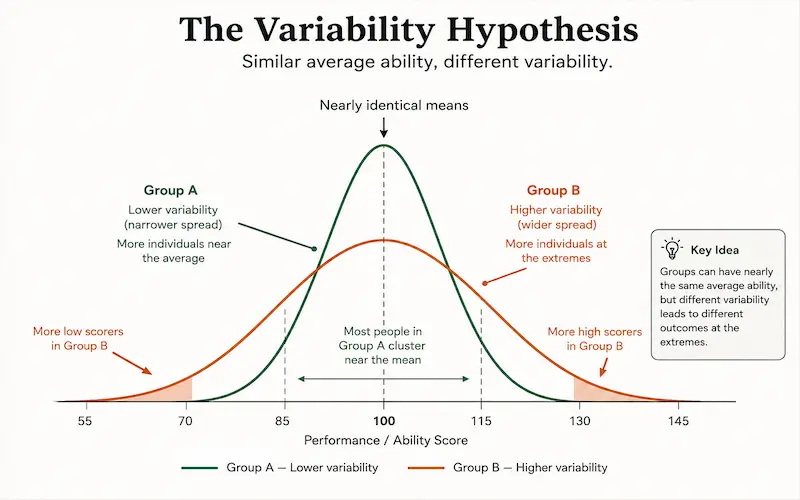
The robust, replicated pattern is the variability difference: male scores tend to be more spread out than female scores. Same average, wider distribution. The consequence is arithmetic — if one group's scores spread more widely around the same mean, that group will be overrepresented at both tails, high and low. Johnson, Carothers and Deary examined this directly in 2008, using two population-wide surveys of Scottish eleven-year-olds — close to every child of that age, not a convenience sample. They confirmed greater male variability and overrepresentation of males at both extremes, alongside a negligible difference in the average. They also found the real distribution departs from a tidy bell curve, with less variability at the high end than a normal distribution would predict — a detail that should make anyone cautious about confident claims out at the tails, including claims about the highest IQ scores ever recorded. The overrepresentation cuts both ways Greater male variability is often quoted to explain male overrepresentation at the very top of some fields. The same fact overrepresents men at the bottom of the distribution — among those who struggle most. A wider spread is not a ranking. It is not evidence that either sex is "better"; it is a statement about dispersion, and it says nothing about any individual.
Specific abilities differ — modestly, in both directions
| Ability | Typical finding | Size |
|---|---|---|
| Mental rotation (a spatial task) | Small average male advantage | Small–moderate |
| Some verbal fluency and writing tasks | Small average female advantage | Small |
| Processing speed and clerical tasks | Small average female advantage | Small |
| Overall general intelligence (g) | Negligible average difference | ~Zero |
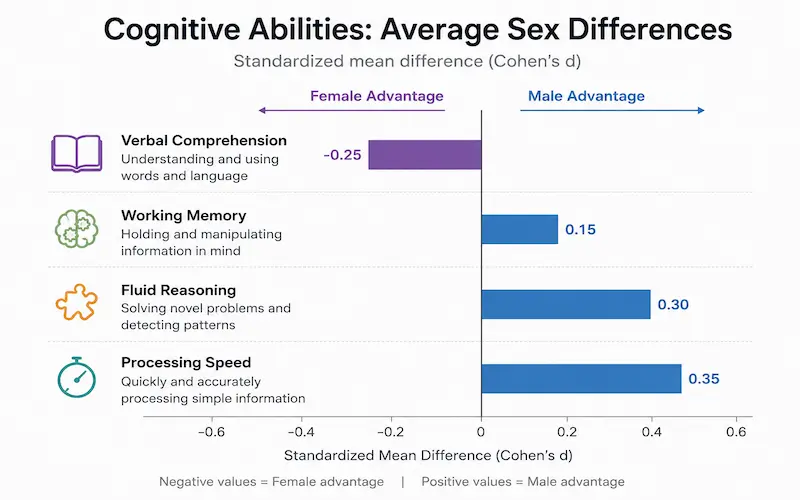
Two cautions keep these honest. First, the differences are averages over huge, overlapping distributions: knowing someone's sex tells you almost nothing about their spatial or verbal ability. Second, a curious pattern recurs in specific tasks — on the cognitive reflection test, for instance, men score higher on average, yet women in the same samples score higher on a broad ability measure taken alongside it, a finding Frederick documented in his original 2005 paper introducing the test.
The differences that exist are not fixed
The specific ability most often cited for a male average edge — spatial reasoning, especially mental rotation — is also one of the most trainable cognitive skills there is. Uttal and colleagues' 2013 meta-analysis of spatial training studies, published in Psychological Bulletin, found substantial, durable improvement that transferred to untrained spatial tasks, across ages and regardless of sex. That reframes the difference. A gap that shrinks with practice is not a fixed biological ceiling; it is, at least in part, a difference in exposure and experience that responds to opportunity. The same training that improves spatial performance generally improves it for whoever practises, which is exactly what you would not expect if the difference were an immovable trait.
How to hold all three facts at once
The distortions in this area almost always come from keeping one of the three facts and dropping the others. Quote the variability finding alone and you imply male superiority; the overrepresentation at the bottom vanishes. Quote the negligible mean alone and you erase real, measurable differences in specific abilities. Quote a single task gap and you smuggle it in as a claim about overall intelligence. The defensible summary is unglamorous and complete: average general intelligence is essentially equal; male scores are somewhat more variable, which overrepresents men at both extremes; specific abilities differ modestly in both directions; and the clearest of those differences responds to training. None of it licenses a claim about any individual, because the distributions overlap almost entirely — the same reason group averages of any kind tell you nothing about the person in front of you.
Sources
- Johnson, W., Carothers, A., & Deary, I. J. (2008). "Sex differences in variability in general intelligence: A new look at the old question." Perspectives on Psychological Science, 3(6), 518–531. — https://doi.org/10.1111/j.1745-6924.2008.00096.x
- Uttal, D. H., Meadow, N. G., Tipton, E., Hand, L. L., Alden, A. R., Warren, C., & Newcombe, N. S. (2013). "The malleability of spatial skills: A meta-analysis of training studies." Psychological Bulletin, 139(2), 352–402. — https://doi.org/10.1037/a0028446
- Frederick, S. (2005). "Cognitive Reflection and Decision Making." Journal of Economic Perspectives, 19(4), 25–42. — https://doi.org/10.1257/089533005775196732
- Deary, I. J. (2020). Intelligence: A Very Short Introduction (2nd ed.). Oxford University Press.
- Neisser, U., et al. (1996). "Intelligence: Knowns and Unknowns." American Psychologist, 51(2). APA.
Frequently asked questions
Are men or women more intelligent?+
Neither, on average. On general intelligence the mean difference between the sexes is negligible — a point or two at most in large samples, well within the noise and useless for predicting anything about an individual.
What is the variability hypothesis?+
It is the observation that male cognitive scores tend to be more spread out than female scores around a similar average. Because a wider spread puts more people at both extremes, it overrepresents men at both the high and the low ends. Johnson, Carothers and Deary (2008) confirmed this pattern in population-wide data on Scottish eleven-year-olds.
Does greater male variability mean men are more likely to be geniuses?+
It means men are somewhat overrepresented at the extreme high end — and equally at the extreme low end. Greater variability is not superiority; it is a wider spread around the same average.
Do men and women differ on specific mental abilities?+
Yes, modestly and in both directions. There is a small average male advantage on some spatial tasks such as mental rotation, and small average female advantages on some verbal-fluency and processing-speed tasks.
Is the male advantage in spatial ability fixed?+
No. Spatial reasoning is among the most trainable cognitive skills. Uttal and colleagues' 2013 meta-analysis found spatial training produces substantial, durable gains that transfer to untrained spatial tasks, across ages and regardless of sex.
Why do IQ tests show little overall sex difference?+
Partly because the tests are built and normed to measure a general factor, and items producing large sex gaps have historically been balanced or removed. But the underlying general factor also shows only a negligible mean difference, so the near-equality is not merely an artefact of test construction.
Does the distribution actually follow a normal bell curve at the extremes?+
Not exactly. Johnson, Carothers and Deary (2008) found the real distribution shows less variability at the very high end than a standard normal curve would predict — a reason for caution around confident claims about representation at the extreme tails.
Find out your IQ
Take the free IQ test and get your score, percentile, and a full cognitive breakdown in about 12 minutes.
Start Free Test