What Was Stephen Hawking's IQ? The 160 Claim vs the Evidence
- Written by
- IQCognify Editorial Team
- Reviewed for accuracy
- IQCognify Research Review Process
- Last updated
- Reading time
- 8 min
Quick answer
Stephen Hawking's IQ is unknown. There is no record of him ever publishing an IQ test result, and when The New York Times asked him directly in 2004, he answered: "I have no idea. People who boast about their I.Q. are losers." The figure of 160 that appears on many websites is an estimate with no traceable source. What we do have is a remarkable record: a first-class Oxford degree, landmark work on black holes, and more than five decades of research after a diagnosis that was expected to kill him in two years.
What was Stephen Hawking's IQ?
Short answer
Nobody knows. Hawking never published an IQ score, and when asked he said he had "no idea". The widely repeated 160 is an unsourced estimate, not a test result.
Search for Hawking's IQ and you will see 160 stated as if it were fact. Some pages go further and claim he gave the number himself. Neither is true. We could find no test record, no published study estimating his IQ and no interview in which he named a score.
What we do have is his own answer to the question. In a 2004 interview with The New York Times Magazine, Deborah Solomon asked him directly: "What is your I.Q.?" Hawking replied: "I have no idea. People who boast about their I.Q. are losers."
So any honest answer has two parts. First, his IQ is unknown. Second, his recorded achievements tell us far more about his mind than a single test score could.
Where does the "160" figure come from?
The number 160 appears to be borrowed rather than measured. It is the same figure that popular lists give Albert Einstein, who also never took an IQ test, and the two names are usually listed side by side. That looks like a convenient round number for "genius" attached to famous scientists — but this is our inference, not a documented origin.
Real attempts to estimate the IQs of historical figures do exist. In 1926, psychologist Catharine Cox estimated the childhood IQs of about 300 eminent people from their biographies. But her study covered people born between 1450 and 1850 — Hawking was born in 1942, so he could not have been in it. No similar study of Hawking has been published.
| Claim | Where you see it | Evidence | Verdict |
|---|---|---|---|
| His IQ was 160 | Many IQ sites and lists | No test record; no study; no statement by Hawking | Unverified estimate |
| He said his IQ was 160 | Some fan and quiz sites | Contradicted by his 2004 NYT interview: "I have no idea" | False |
| His IQ was between 150 and 170 | Some IQ test sellers | A range invented by the site itself | Unsourced |
| His IQ was as high as 200 | Some blogs | No source given | Unsourced |
| He took a Mensa test after his diagnosis | Online stories | No credible record found | Unsupported |
| He had the same IQ as Einstein | Many lists | Neither man is known to have taken a test | Borrowed number |
What Hawking said about IQ
The full exchange from the 2004 interview is more revealing than the famous one-liner. Asked how we can know whether he qualifies as a genius, Hawking pushed back on the idea of a clear category of geniuses at all:
The media need superheroes in science just as in every sphere of life, but there is really a continuous range of abilities with no clear dividing line.— Stephen Hawking, The New York Times Magazine, 12 December 2004
Pressed on whether he was saying he was not a genius, he answered: "I hope I'm near the upper end of the range." It is a careful, modest view — and it matches how psychologists actually think about intelligence: as a continuous scale, not a club with a membership score.
What IQ counts as genius? — Why "genius" is not an official IQ category, and where the line is usually drawn.What would an IQ of 160 actually mean?
Even as a hypothetical, 160 is often misunderstood. Modern IQ tests are scaled so the average is 100 and the standard deviation is 15. On that scale, a score of 160 is four standard deviations above average — roughly 1 person in 31,574.
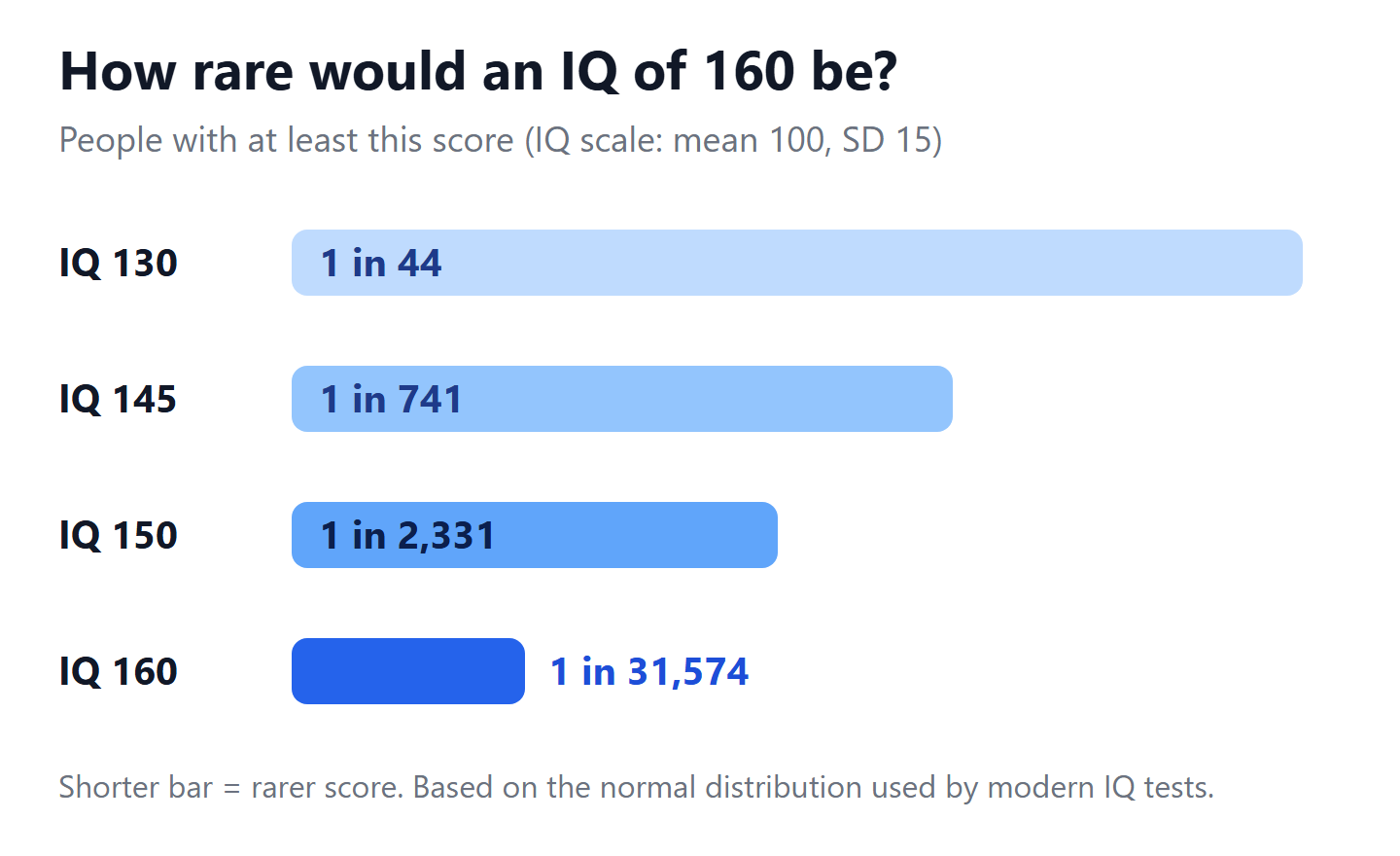
Some popular pages get these numbers badly wrong. One claims that scores above 145 occur in about "1 in 1,000,000" people; the correct figure is about 1 in 741.
The same number can also mean different things on different tests. Older versions of the Stanford-Binet used a standard deviation of 16, on which 160 is about 1 in 11,000. And most adult tests are not designed to measure precisely at that extreme: very few people score there, so the test has little data to work with. That is one more reason a single "160" says less than it seems.
Convert any IQ to a percentile — See exactly how common any score is, from 70 to 160.Hawking's record: from the middle of the class to the Lucasian chair
Hawking was not an obvious prodigy. His official biography says he was "never more than halfway up the class" at St Albans School — although his classmates nicknamed him "Einstein". At Oxford he later estimated he studied only about a thousand hours in three years, and his final result was borderline enough to need an oral exam before he was awarded a first-class degree in 1962.
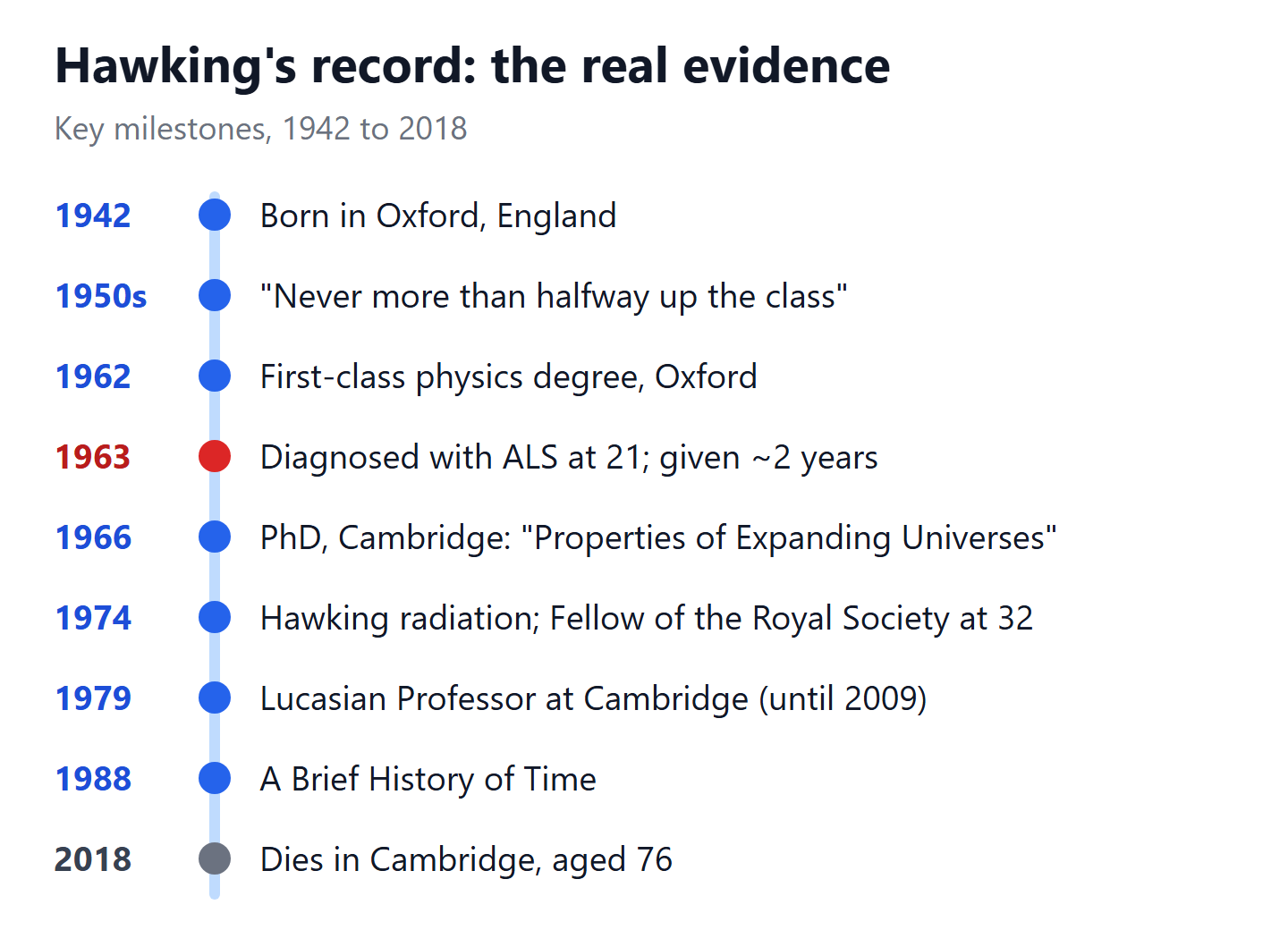
- 1966: PhD at Cambridge with the thesis "Properties of Expanding Universes".
- 1970: with Roger Penrose, showed that the universe must have begun in a singularity if general relativity is correct.
- 1974: published "Black hole explosions?" in Nature, predicting that black holes emit radiation — now called Hawking radiation.
- 1974: elected a Fellow of the Royal Society at 32, one of the youngest ever.
- 1979 to 2009: Lucasian Professor of Mathematics at Cambridge, the chair once held by Isaac Newton.
- 1988: A Brief History of Time, which has sold more than 20 million copies according to his estate's official site.
He never won a Nobel Prize, because Hawking radiation has not yet been confirmed by experiment. But his work reshaped how physicists think about black holes, quantum theory and the origin of the universe.
Did ALS affect Stephen Hawking's intelligence?
Hawking was diagnosed with motor neurone disease, also known as ALS, in 1963 at the age of 21 and was given about two years to live. He lived another 55 years. His form of the disease was unusually slow-progressing, and over time he lost nearly all movement and his natural voice.
It is often said that ALS "leaves the mind untouched". Research shows it is more complicated. In a study of 279 people with ALS, about half showed some cognitive impairment, mostly mild changes in planning and memory, and about 15% met the criteria for frontotemporal dementia (Ringholz and colleagues, 2005). A 2021 review put cognitive change at up to 65% of patients.
No published assessment of Hawking's own cognition exists. But his continuous output of papers and books until his death in 2018 is strong evidence that his reasoning remained intact — which, given the research, makes his case even more remarkable.
Not medical advice
If you or someone you know has ALS and is noticing changes in thinking or behaviour, speak to a neurologist. Cognitive changes in ALS are common and can be assessed and supported.
Stephen Hawking vs Albert Einstein vs Elon Musk
Comparisons like these are popular, but there are no real scores to compare. Here is what is actually known.
| Person | Published IQ score | Commonly quoted figure | Status |
|---|---|---|---|
| Stephen Hawking | None | 160 | Unverified estimate |
| Albert Einstein | None | 160 | Unverified estimate |
| Elon Musk | None | Various figures circulate | Unverified estimate |
Does IQ explain Hawking's achievements?
Only partly. Psychologist Dean Keith Simonton, who reviewed decades of research estimating the intelligence of eminent people from historical records, found that estimated intelligence is related to eminence — but only modestly (Simonton, 2009). That leaves most of the difference in eminence explained by other things: creativity, persistence, training, collaboration and opportunity.
Hawking's story fits that picture. A middling school record, a borderline final exam and a devastating diagnosis would not have predicted his career. What set him apart was not a measured number but what he did over five decades.
Does IQ predict success? — What decades of research say about IQ, careers and achievement.Take the free IQ test — 27 questions, about 12 minutes, with an instant score and a breakdown of your abilities.Sources
- Solomon, D. (2004). The Science of Second-Guessing: Questions for Stephen Hawking. The New York Times Magazine, 12 December 2004.
- Hawking, S. W. (1974). Black hole explosions? Nature, 248, 30–31. https://doi.org/10.1038/248030a0
- Hawking, S. W. (1966). Properties of Expanding Universes (PhD thesis). University of Cambridge. https://doi.org/10.17863/CAM.11283
- Carr, B. J., et al. (2019). Stephen William Hawking CH CBE. 8 January 1942 — 14 March 2018. Biographical Memoirs of Fellows of the Royal Society, 66, 267–308. https://doi.org/10.1098/rsbm.2019.0001
- The official Stephen Hawking biography, hawking.org.uk.
- University of Cambridge: Professor Stephen Hawking (cam.ac.uk/stephenhawking).
- Ringholz, G. M., et al. (2005). Prevalence and patterns of cognitive impairment in sporadic ALS. Neurology, 65(4), 586–590. https://doi.org/10.1212/01.wnl.0000172911.39167.b6
- Rusina, R., Vandenberghe, R., & Bruffaerts, R. (2021). Cognitive and Behavioral Manifestations in ALS: Beyond Motor System Involvement. Diagnostics, 11(4), 624. https://doi.org/10.3390/diagnostics11040624
- Simonton, D. K. (2009). The "Other IQ": Historiometric assessments of intelligence and related constructs. Review of General Psychology, 13(4), 315–326. https://doi.org/10.1037/a0017141
- Cox, C. M. (1926). Genetic Studies of Genius, Vol. II: The Early Mental Traits of Three Hundred Geniuses. Stanford University Press.
Frequently asked questions
What was Stephen Hawking's IQ?+
It is unknown. Hawking never published an IQ score, and in a 2004 New York Times interview he said: "I have no idea. People who boast about their I.Q. are losers." The figure of 160 seen online is an unsourced estimate.
Did Stephen Hawking have an IQ of 160?+
There is no evidence for it. No test record, published study or statement by Hawking supports 160. It appears to be borrowed from similar claims about Einstein, who also never took an IQ test.
Did Stephen Hawking ever take an IQ test?+
No record of an IQ test result for Hawking has been published, and he said he did not know his IQ. Stories that he took a Mensa test after his diagnosis are unsupported.
What did Stephen Hawking say about IQ?+
When asked his IQ in 2004 he said "I have no idea. People who boast about their I.Q. are losers." He added that ability is "a continuous range of abilities with no clear dividing line" and that he hoped he was "near the upper end of the range".
How rare is an IQ of 160?+
On the modern IQ scale (mean 100, standard deviation 15), a score of 160 or higher occurs in about 1 in 31,574 people. On older tests with a standard deviation of 16, the same score is about 1 in 11,000.
Who had a higher IQ, Stephen Hawking or Einstein?+
No one can say. Neither man is known to have taken an IQ test, and both are usually given the same unsourced figure of 160.
Did ALS affect Stephen Hawking's intelligence?+
Research shows about half of people with ALS develop some change in thinking, usually mild. Hawking had an unusually slow-progressing form, and his continuous research output until 2018 suggests his reasoning stayed intact. No published assessment of his cognition exists.
Was Stephen Hawking a genius?+
By any everyday definition, yes: his work on black holes and the origin of the universe changed physics. Hawking himself preferred to say there is a continuous range of ability and that he hoped he was "near the upper end of the range".
Find out your IQ
Take the free IQ test and get your score, percentile, and a full cognitive breakdown in about 12 minutes.
Start Free Test