
Test Anxiety and IQ Tests: How Much Does It Cost You?
- Written by
- IQCognify Editorial Team
- Reviewed for accuracy
- IQCognify Research Review Process
- Last updated
- Reading time
- 6 min
Quick answer
Test anxiety measurably lowers IQ scores — but the damage comes from the worry/cognitive-interference component, not physical arousal like a racing heart. Some subtests are far more vulnerable than others, particularly those loading heavily on working memory and processing speed.
How large is the effect, really?
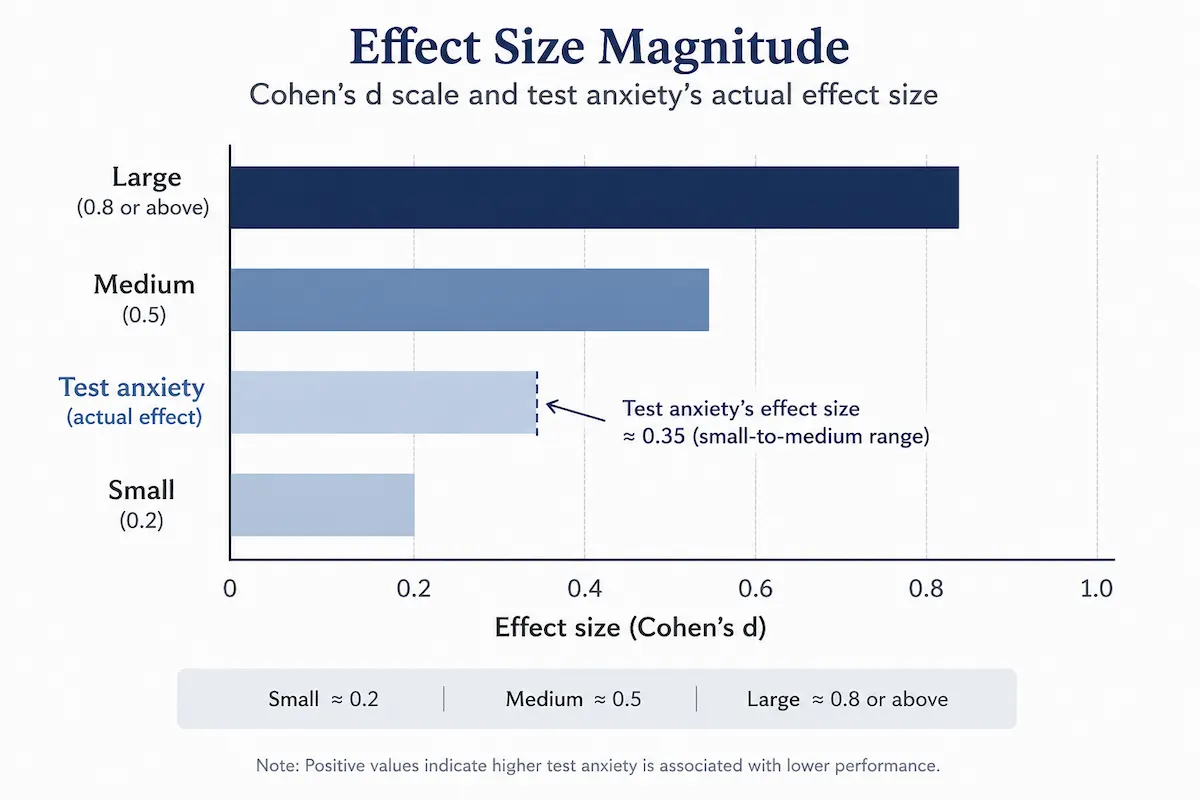
The most comprehensive answer comes from a meta-analytic review by von der Embse and colleagues, published in the Journal of Affective Disorders in 2018, which pooled 238 studies conducted since 1988. Test anxiety was significantly and negatively related to a broad range of performance outcomes — standardised tests, university entrance exams, grade point average — with effect sizes in the small-to-medium range. That phrasing deserves to be taken seriously in both directions. Test anxiety is not a myth, and the effect is not zero. Nor is it a trapdoor. A small-to-medium effect does not mean an anxious person with an IQ of 130 is going to test at 100. It means scores drift downward, modestly, on average, in ways that matter most at the margins — near a cutoff, near a threshold, near a decision — the same margin-of-error logic that applies to reading any IQ percentile.
The worrying does the damage, not the racing heart
This is the finding that should change what you do about it, and it is almost universally ignored in the advice you will find elsewhere. Test anxiety is not one thing. It divides into a cognitive component — worry, self-doubt, intrusive thoughts about failing, attention pulled toward the consequences of the test rather than the test — and an emotional or physiological component: the racing heart, the sweating palms, the churn in the stomach. The 2018 meta-analysis found that test performance is more strongly related to the cognitive side than to the emotional side. There is a straightforward mechanistic reason to expect exactly that. Intrusive worry consumes working memory — the limited capacity you use to hold and manipulate information while you solve a problem. Every slot occupied by "I am going to fail this" is a slot unavailable for the item in front of you. A racing heart consumes no working memory at all.
Why standard advice underperforms
Breathing exercises and relaxation techniques target the physiological component — the half that predicts performance less well. They may make the experience more pleasant, which is worth something. They are aimed at the weaker of the two mechanisms, and it is worth knowing that before you rely on them.
Which parts of a test are most exposed
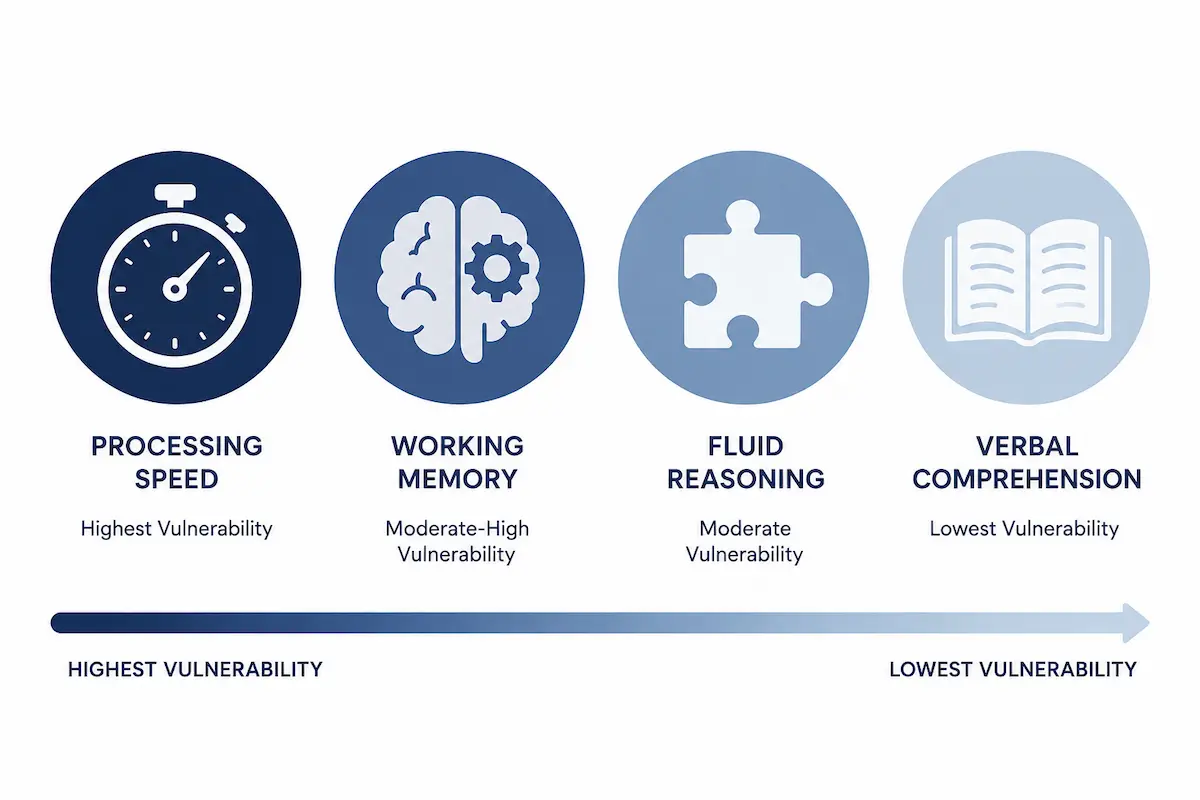
Anxiety does not degrade a cognitive test evenly. It goes after the parts that are speeded and shallow.
| Index | Why it is exposed | Vulnerability |
|---|---|---|
| Processing speed | Strictly timed, trivially easy items; pure clerical throughput | Highest |
| Working memory | Directly consumed by intrusive worry | High |
| Fluid reasoning | Harder items, less time pressure, more absorbing | Moderate |
| Verbal comprehension | Draws on stored knowledge, which is stable | Lowest |
Processing-speed subtests are the most fragile things on a Wechsler scale precisely because they are easy. There is nothing to think about; the only variable is how fast you can execute a simple operation under a clock. That makes them acutely sensitive to state — anxiety, fatigue, medication, attention, motor control — and comparatively insensitive to reasoning. The profession already knows this. It is one reason the General Ability Index exists: a composite that deliberately excludes working memory and processing speed, on the grounds that those indexes can be depressed by things that are not reasoning. When a clinician sees a large gap between the reasoning indexes and the speed and memory indexes, the possibility that the test caught the person on a bad day is a live hypothesis, not an excuse — the same reasoning that underlies the g factor's distinction between a single test score and the broader construct it's meant to estimate.
Would you really have scored higher?
Probably by a little. Almost certainly not by as much as you think, and here is the honest way to check. Every score is a range, not a point. A good individually administered test carries a standard error of measurement of roughly three to five points, which means the same person tested twice in identical conditions will produce different numbers. A test report that says 118 is really saying something closer to "most likely somewhere around 113 to 123". A modest anxiety effect lives comfortably inside that band. So the realistic picture is not that anxiety cost you twenty points. It is that anxiety may have nudged you a few points down, within a range that was always wider than the single number suggested. That is enough to matter if you are sitting on a gifted threshold or an entrance cutoff. It is not enough to mean that the score is meaningless, and it is not enough to explain away a result that is far from what you expected. It is also worth being blunt about a self-serving version of this argument. "I was anxious" is available to everyone, always, and it is unfalsifiable after the fact. The evidence supports a modest effect concentrated in specific subtests — it does not support treating any disappointing score as an artefact.
What actually follows from the evidence
- Familiarity beats relaxation. Not knowing what a test looks like is itself a source of worry, and worry is the component that costs you. Working through sample items removes uncertainty about format — though it does not raise your underlying ability
- Watch the timed, easy sections. If anxiety is going to cost you anywhere, it is on the speeded clerical subtests, not the hard reasoning ones.
- Treat a single score as a range. If a result is far below expectation and there were real conditions on the day, a retest after a suitable interval is a legitimate step, not special pleading.
- Be sceptical of an unproctored score. On an online test there is no examiner to notice that you are distressed, distracted or interrupted — and no standardised conditions to compare you against in the first place.
This is not medical advice
Severe or persistent anxiety — the kind that interferes with daily life rather than a single test — is a matter for a qualified clinician, not an article. Nothing here is a diagnosis or a treatment plan, and no online test can provide one.
Sources
- von der Embse, N., Jester, D., Roy, D., & Post, J. (2018). "Test anxiety effects, predictors, and correlates: A 30-year meta-analytic review." Journal of Affective Disorders, 227, 483–493. — https://doi.org/10.1016/j.jad.2017.11.048
- American Educational Research Association, American Psychological Association, & National Council on Measurement in Education (2014). Standards for Educational and Psychological Testing. AERA.
- Canivez, G. L., Watkins, M. W., & Dombrowski, S. C. (2017). "Structural validity of the Wechsler Intelligence Scale for Children–Fifth Edition." Psychological Assessment, 29(4), 458–472. — https://doi.org/10.1037/pas0000358
- Pearson — Wechsler Adult Intelligence Scale (WAIS) and Wechsler Intelligence Scale for Children (WISC): technical and interpretive materials.
- Deary, I. J. (2020). Intelligence: A Very Short Introduction (2nd ed.). Oxford University Press.
Frequently asked questions
Does test anxiety lower your IQ score?+
Yes, but modestly. A meta-analytic review of 238 studies (von der Embse et al., 2018) found test anxiety was significantly and negatively related to performance on standardised tests, with effect sizes in the small-to-medium range. It nudges scores down; it does not typically move someone across large stretches of the distribution.
What kind of test anxiety hurts performance most?+
The cognitive kind — worry and intrusive thoughts — rather than the physiological kind. The 2018 meta-analysis found performance is more strongly related to the cognitive component than the emotional one. The likely mechanism is that worry occupies working memory, the very capacity you need to solve the items, whereas a racing heart does not.
Do breathing and relaxation techniques help with test anxiety?+
They target the physiological component, which is the half less strongly related to performance. That does not make them worthless — a calmer experience has value in itself — but the evidence suggests the worry component does more of the damage, so techniques aimed only at bodily calm are addressing the weaker mechanism.
Which IQ subtests are most affected by anxiety?+
Processing speed is the most exposed, because those subtests are strictly timed and deliberately easy, so performance depends on uninterrupted clerical throughput rather than thinking. Working memory is next, as intrusive worry consumes it directly. Verbal comprehension is the most robust, because it draws on stored knowledge.
Should I retake an IQ test if I was anxious?+
It can be reasonable, particularly if the result is far below expectation and there were genuine conditions on the day. Every score carries a standard error of roughly three to five points, so retesting after a suitable interval may produce a different figure. Bear in mind that practice effects can inflate a second score slightly, which is why a decent gap between sittings is normally required.
How can I tell whether anxiety affected my score?+
One useful signal is the shape of the profile rather than the total. A large gap between strong reasoning indexes and weak processing-speed or working-memory indexes is consistent with state factors such as anxiety, fatigue or attention difficulties — which is precisely why the General Ability Index, which excludes those two indexes, exists.
Find out your IQ
Take the free IQ test and get your score, percentile, and a full cognitive breakdown in about 12 minutes.
Start Free Test