
The Wonderlic Test: What It Actually Measures, and Why the NFL Dropped It
- Written by
- IQCognify Editorial Team
- Reviewed for accuracy
- IQCognify Research Review Process
- Last updated
- Reading time
- 5 min
Quick answer
The Wonderlic Personnel Test is a 50-question, 12-minute cognitive ability test used by over 30,000 employers, best known for decades of use at the NFL Scouting Combine (dropped in 2022). It correlates strongly with full IQ tests in some studies (r = 0.85-0.93 with the WAIS) but more modestly in others — and newer research suggests it may track working memory more specifically than general fluid intelligence.
What it actually is
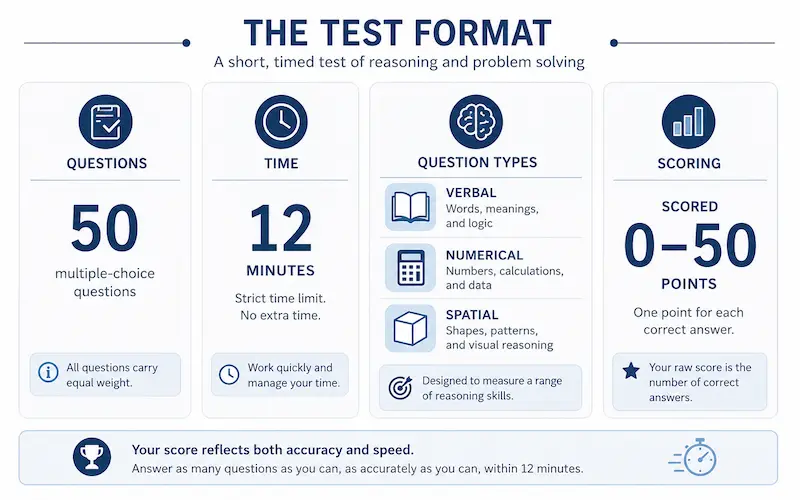
The Wonderlic Personnel Test — now marketed as the Wonderlic Contemporary Cognitive Ability Test — is a 50-item, 12-minute timed assessment covering verbal, numerical, and spatial reasoning: word comparisons, disarranged sentences, number series, and geometric problems. It was created in 1936 by Eldon F. Wonderlic, and by the time it reached its widest public recognition, it was in use by more than 30,000 employers, along with the U.S. Armed Forces and companies like AT&T. Scoring is simple on its face: a raw score from 0 to 50, with roughly 20 traditionally cited as the average adult score. That simplicity is part of why it spread so widely as a hiring tool — it's fast to administer and easy to explain to a non-technical hiring manager, which is not true of most full IQ batteries.
Why most people have heard of it: the NFL
The Wonderlic's public fame has almost nothing to do with its use in ordinary hiring and almost everything to do with football. Tom Landry, the legendary Dallas Cowboys coach, is widely credited with introducing it to NFL scouting in the 1970s, reportedly leaning on it during a decade that saw Dallas reach four Super Bowls. From there it became a fixture of the NFL Scouting Combine — every draft prospect, from offensive linemen to quarterbacks, sat the same 50-question, 12-minute test, and scores would leak and become part of draft-night narrative. That fixture status ended abruptly. Starting with the 2022 Combine, the NFL removed the Wonderlic from its official evaluation process. Troy Vincent, the league's executive vice president of football operations, called it an "outdated process." The underlying reason tracked what researchers had argued for years: most academic studies found weak or no correlation between Wonderlic scores and actual NFL career success once you controlled for playing position — a 12-minute paper test, whatever it measures, does not measure whether someone can read a defense at full speed. A test being widely used doesn't mean it predicts what it's used for The Wonderlic's NFL story is a clean, public illustration of a distinction that matters far beyond football: a test can be reliable (it measures something consistently) without being predictively valid for the specific outcome it's being used to forecast. Decades of NFL use did not, on its own, establish that the test predicted on-field performance — and once researchers actually checked, the predictive relationship was weak.
Does it actually measure IQ?
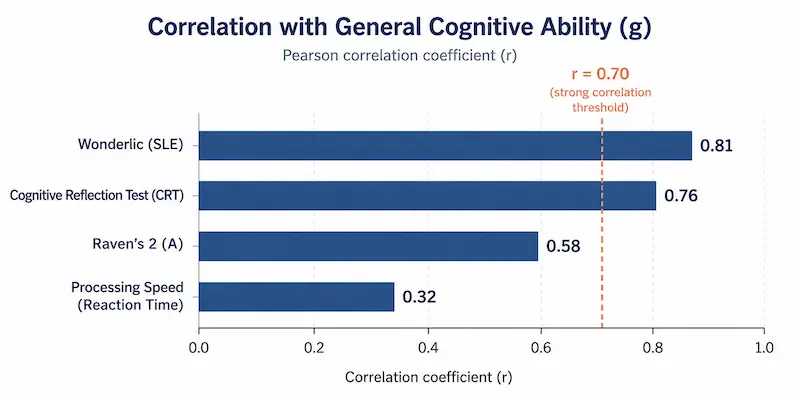
This is where the research gets genuinely more interesting than most summaries let on, because the studies disagree by a meaningful margin.
| Study | Comparison test | Correlation (r) |
|---|---|---|
| Dodrill & Warner, 1988 | WAIS Full Scale IQ | 0.85–0.93 |
| Buckley, 1957 (Master's thesis) | WAIS Verbal IQ | 0.63 |
| Matthews & Lassiter, published in Psychological Reports | Woodcock-Johnson Broad Cognitive Ability | 0.55 |
| Matthews & Lassiter (same study) | Woodcock-Johnson fluid reasoning specifically | 0.26 (not significant) |
That spread is not noise to be waved away — it's informative. The strongest correlations come from studies comparing the Wonderlic to a test's overall composite score. When researchers isolate fluid reasoning specifically — the kind of on-the-spot novel problem-solving g is most associated with — the relationship gets much weaker, and in the Matthews & Lassiter study, not statistically significant at all.
The working-memory finding that complicates the picture further
A 2015 study published in Intelligence pushed this question further and found something genuinely surprising: once researchers statistically accounted for working memory capacity, the Wonderlic's relationship to fluid intelligence essentially disappeared. In other words, whatever the Wonderlic captures about "fluid intelligence" may actually be working memory wearing fluid intelligence's clothes — a distinct, related, but not identical cognitive resource. The same study found the Wonderlic was a meaningfully better predictor of working memory capacity among people with lower fluid intelligence than among people with higher fluid intelligence — meaning its usefulness as a quick proxy isn't even consistent across the ability range it's used on. For a test given to 30,000+ employers as a stand-in for general cognitive ability, that's a real limitation worth knowing, not a technicality.
Why score gaps between groups matter legally, not just statistically
Because the Wonderlic is highly g-loaded in at least some of the research above, it inherits a property common to general cognitive ability tests: measurable average score differences can appear between demographic groups. In U.S. employment law, this triggers real obligations. Under disparate-impact doctrine established in cases like Griggs v. Duke Power Co. (1971), an employer using a test that produces such gaps must be prepared to demonstrate the test is genuinely job-related and consistent with business necessity — not simply convenient or traditional. This is precisely why "the Wonderlic is legally defensible as a selection tool only when validated for the specific job in question" isn't legal boilerplate — it's the direct, practical consequence of the test's own statistical properties. A company using a 12-minute test to screen forklift operators and a company using it to screen software engineers face very different validation burdens, because the job-relatedness case is not the same.
What a Wonderlic score roughly corresponds to
- Raw score ~20 → commonly cited as roughly average, corresponding to an IQ near 100 on conversion tables.
- Conversion tables vary by source — Dodrill's 1980/1981 tables are the most commonly cited, but because multiple conversion methods exist, the "IQ equivalent" you'll see quoted online can differ depending on which table was used.
- Clinical "hit rate" research — in populations tested for both, 81-94% of Wonderlic scores fell within 10 points of a full WAIS score, per Dodrill's own clinical validity criterion — useful as a rough screen, not as a replacement for full individually administered testing.
- It is not equivalent to a Full Scale IQ score from a real Wechsler or Stanford-Binet administration, and treating it as interchangeable overstates what a 12-minute group-administered test can establish about an individual.
Sources
- Dodrill, C. B., & Warner, M. H. (1988). "Further studies of the Wonderlic Personnel Test as a brief measure of intelligence." Journal of Consulting and Clinical Psychology, 56(1), 145–147. — https://doi.org/10.1037/0022-006X.56.1.145
- Matthews, T. D., & Lassiter, K. S. (2007). "What Does the Wonderlic Personnel Test Measure?" Psychological Reports. — https://pubmed.ncbi.nlm.nih.gov/17688083/
- Unsworth, N., et al. (2015). "Wonderlic, working memory capacity, and fluid intelligence." Intelligence, 50, 205–212. — https://doi.org/10.1016/j.intell.2015.04.007
- Griggs v. Duke Power Co., 401 U.S. 424 (1971). Supreme Court of the United States.
- Deary, I. J. (2020). Intelligence: A Very Short Introduction (2nd ed.). Oxford University Press.
Frequently asked questions
What is the Wonderlic test?+
It's a 50-question, 12-minute cognitive ability test created in 1936 by Eldon F. Wonderlic, used by tens of thousands of employers and, for decades, the NFL Scouting Combine. It covers verbal, numerical, and spatial reasoning items.
Why did the NFL stop using the Wonderlic test?+
The NFL removed it starting with the 2022 Scouting Combine. League officials called it an "outdated process," reflecting years of debate about whether it meaningfully predicted on-field success — most academic studies found weak or no correlation between Wonderlic scores and NFL career outcomes once position was controlled for.
Is the Wonderlic test the same as an IQ test?+
Not exactly. It correlates with full IQ tests, but studies disagree substantially on how strongly — anywhere from r = 0.26 (not significant, for fluid reasoning specifically) to r = 0.85-0.93 (for overall composite scores) depending on the comparison test and sample. A 2015 study found its relationship to fluid intelligence largely disappears once working memory is accounted for, suggesting it may measure something narrower than general IQ.
What is a good Wonderlic score?+
A raw score around 20 is traditionally cited as average, roughly corresponding to an IQ near 100 on commonly used conversion tables. Different conversion methods (Dodrill's 1980 and 1981 tables are the most cited) can produce slightly different IQ-equivalent figures for the same raw score.
Can employers legally use the Wonderlic to make hiring decisions?+
Yes, but with real requirements. Because cognitive ability tests like the Wonderlic can produce average score differences between demographic groups, U.S. disparate-impact law (following Griggs v. Duke Power Co., 1971) requires employers to demonstrate the test is genuinely job-related for the specific position, not simply a convenient general screen.
Does a Wonderlic score predict job or career performance?+
It depends heavily on the job and how the score is used. The NFL experience is a well-documented case where decades of use did not translate into strong predictive validity for the specific outcome (playing performance) it was informally used to forecast. Validity has to be established per job, not assumed from the test's general reputation.
Find out your IQ
Take the free IQ test and get your score, percentile, and a full cognitive breakdown in about 12 minutes.
Start Free Test