123test IQ Test Review 2026: Every Tier, Every Subtest, Explained
- Written by
- IQCognify Editorial Team
- Reviewed for accuracy
- IQCognify Research Review Process
- Last updated
- Reading time
- 6 min
Quick answer
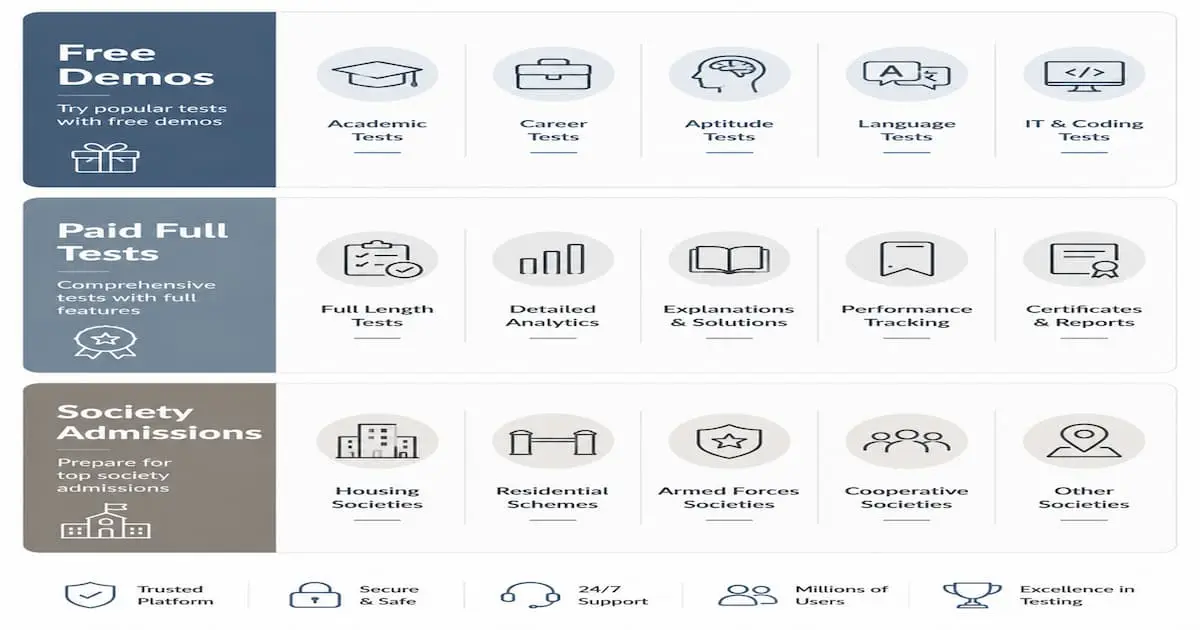
123test.com is an 18-test platform running since 2002–2003, structured across three tiers: free demos, two paid full-length tests (Classical and Culture Fair), and a society-admissions pathway. The Classical Intelligence Test scores four separate subtests — spatial, verbal, numerical, and logical reasoning — and its own published sample report shows real per-section benchmarks. Separately, and more consequentially, its Culture Fair test is the exclusive online admissions instrument of the International High IQ Society: a score of 124+ (top 5%) qualifies you for membership, but only on the paid version. If you want to see where you'd land on that same 100/15 scale before reading further, our free IQ test gives you a score, percentile, and an eight-category cognitive breakdown in about 12 minutes — useful context for judging what 123test's four-subtest structure is actually adding.
It's a platform of 18 tests, not one product
Reviewing "123test" as a single IQ test, the way most ranking content does, misses the actual structure. The platform runs 18 distinct assessments — spatial reasoning, numerical reasoning, verbal reasoning, logical/deductive reasoning, mechanical reasoning, and more — organized into three tiers with meaningfully different accuracy claims: free demos (10–20 questions, explicitly a preview), two paid full-length tests, and a testing pathway that connects to an outside membership organization. That breadth is unusual in this category. Most competitors ship one test format and one score. It's closer to a menu of the different types of IQ tests that exist in the field — power tests, speed tests, nonverbal matrices, verbal batteries — packaged under a single brand rather than built from a single instrument. That's a strength for someone who wants to probe several abilities separately, and a source of confusion for anyone comparing "my 123test score" to "my score on some other site" without checking which of the 18 they actually took.
Inside the Classical Intelligence Test: four subtests, not one score
The Classical Intelligence Test doesn't return a single blended number — it scores four separate components:
| Subtest | What it measures | Format |
|---|---|---|
| Spatial intelligence | Three-dimensional thinking, mental rotation, folding/reshaping figures | Cube-folding and figure-matching items |
| Verbal intelligence | Word meaning, linguistic precision, comprehension speed | Word-relationship and definition items |
| Numeric intelligence | Working with number series and reducing numeric data, not raw arithmetic | Number-series and calculation-logic items |
| Logical reasoning | Identifying and defining abstract relationships between categories | Deductive and inductive reasoning items |
123test's own published sample report gives a rare look at real section-level benchmarks: on a 16-question verbal component, a typical test-taker answers between 11 and 14 correctly. This four-way split is a useful reminder that a single IQ number is always a composite — the same logic behind why neuromyths about "types" of intelligence persist even though the subtests behind a real score are well-defined and separately measured.
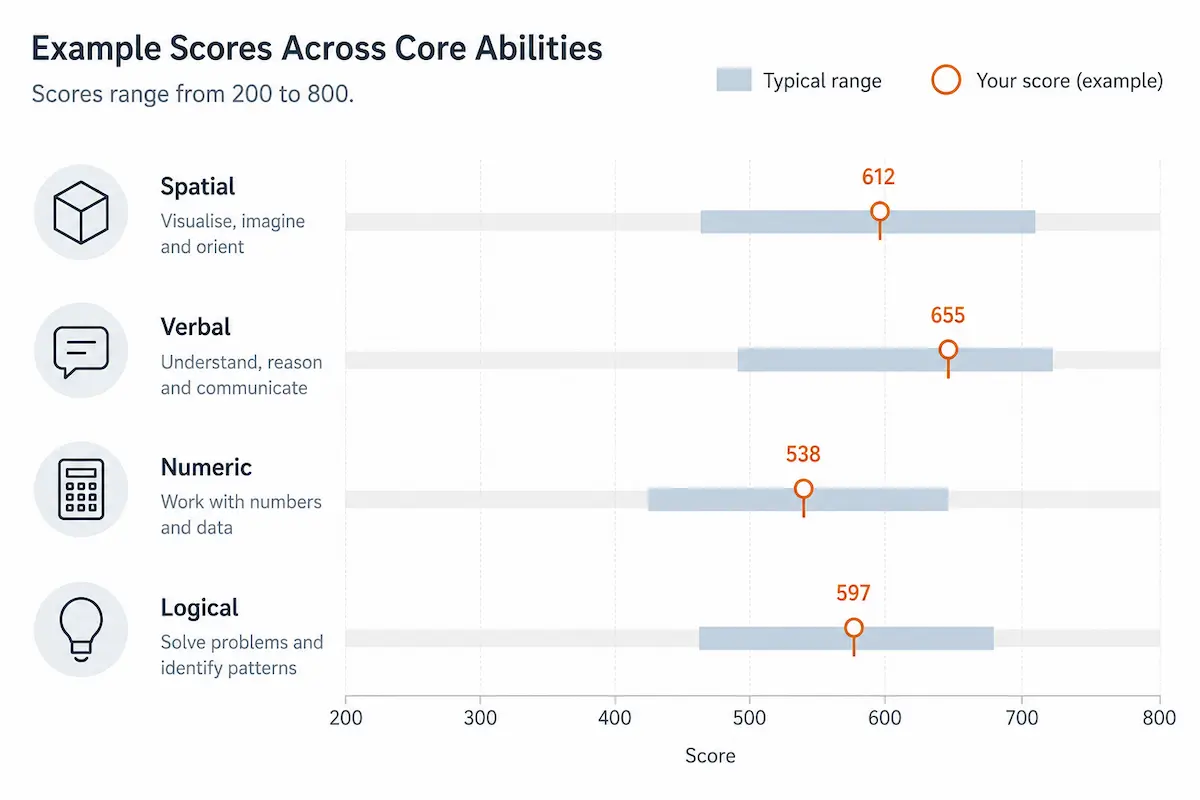
It also maps cleanly onto categories most cognitive-testing sites use under different names. What 123test calls "spatial intelligence" is functionally the same construct covered in a dedicated spatial reasoning breakdown; its "verbal intelligence" subtest sits in the same territory as verbal reasoning sections on other batteries. The four-subtest structure is also a rough echo — not an equivalent — of the fluid vs. crystallized intelligence distinction used in modern psychometrics: numeric and logical reasoning lean fluid (Gf), verbal leans crystallized (Gc), and spatial sits closer to visual-spatial processing (Gv). Knowing which bucket a subtest falls into matters more than the raw score, because fluid and crystallized abilities develop, peak, and decline on different timelines across a person's life.
The society-admissions pathway: 123test's real differentiator
123test's Culture Fair Intelligence Test is built on the progressive-matrices format developed by psychologist John Raven. What sets this test apart is its external role: the International High IQ Society, founded in 2000 by Nathan Haselbauer, states directly that it works exclusively with 123test for online self-administered admissions testing, and does not accept any other unproctored online test as proof of eligibility. The threshold is public: a score of 124 or higher — the top 5% of the general population — qualifies a test-taker to apply, with a downloadable certificate available as supporting evidence. For context on what that percentile actually represents statistically, see how IQ scores map to population percentiles, or check where 124 sits on a full IQ score chart. It's worth being explicit about why "culture fair" matters for a matrices-based test specifically. Raven-style items rely on abstract pattern completion rather than vocabulary, cultural references, or language fluency, which is the whole design premise behind Raven's Progressive Matrices as a format: it was built to reduce the language and education bias that verbal batteries carry. That's also why IHIQS picked it as the admissions instrument over 123test's own Classical test — a verbal-heavy subtest score would be a weaker universal filter than a nonverbal matrices score.
The catch most people miss
The free demo version of the Culture Fair test does not count toward society eligibility. Only the full paid version does. This is the same "read the fine print" instinct worth applying to any test result, free or paid — including recognizing when a test is genuinely built for early identification rather than casual curiosity. It's also worth separating "qualifies for a society" from "accurate cognitive estimate." Those are different claims. A score can be a legitimate admissions credential for a specific membership organization while still carrying the same measurement uncertainty as any other unsupervised online test — see are online IQ tests accurate? for what that uncertainty actually looks like in practice.
How 123test compares to other routes to a number
| Path | Cost | Depth | External recognition |
|---|---|---|---|
| 123test free demo | Free | 10-20 Q, single-tier feedback | None |
| 123test Classical (paid) | ~$9 | 4 scored subtests, benchmarked ranges | None |
| 123test Culture Fair (paid) | ~$9 | Adaptive, Raven-based | International High IQ Society (exclusive) |
| Official Mensa admission test | $35–$60 | Group-proctored session | Mensa |
| WAIS-V (licensed psychologist) | $300–$2,000+ | Full clinical battery | Clinical/legal validity |
If Mensa specifically is the goal rather than IHIQS, the admissions math is different — Mensa requires a 98th-percentile score on an approved, typically proctored instrument, not a self-administered online test. Our Mensa IQ requirements guide and the Mensa Norway test breakdown cover which routes are actually accepted, which is a meaningfully stricter bar than the unproctored path 123test offers into IHIQS.
Where independent reviewers push back — and where that critique doesn't apply
Reviews unaffiliated with 123test describe the platform's breadth and speed favorably but its result depth as moderate, and note some visual-reasoning items are hard to visually differentiate — a design issue that adds scoring noise independent of actual reasoning ability. It's worth being precise about what that critique does and doesn't undercut: it's about interface polish, not about the Culture Fair test's standing with the International High IQ Society.
Why 123test outranks better-reviewed newer platforms
123test's search visibility is substantially a function of having operated continuously since 2002–2003, accumulating domain authority that newer competitors haven't had time to build. That's a long tenure by the standards of online cognitive testing — see the history of IQ testing for how young the online-testing category is relative to the field itself, which only formalized standardized testing in the early 20th century. Traffic and product quality are different variables — a distinction worth keeping in mind alongside other cases where a claim about intelligence circulates widely without solid sourcing behind it, like the "average IQ of doctors" figures repeated across the web.
How this compares to a clinical assessment
No tier of 123test, including the society-admissions test, is equivalent to an individually administered instrument like the WAIS, which carries a standard error of measurement near 3 points and a 95% confidence interval of roughly ±6 points under supervised conditions. IHIQS accepting the Culture Fair test for online admissions is a real credential within that specific context; it isn't a claim of clinical-grade precision. The same gap applies to children's testing specifically — a self-administered adult-format test is not a substitute for a proctored IQ test for children, which uses entirely different norming.
This is not a diagnostic or clinical tool
No tier of 123test substitutes for assessment by a qualified psychologist. Treat every online score as an estimate, regardless of tier or external recognition.
Sources
- International High IQ Society (ihiqs.org) — membership sign-up procedure and organizational history
- 123test.com — Culture Fair Intelligence Test and Classical Intelligence Test product pages
- 123test.com — published sample report, Classical Intelligence Test (subtest-level scoring data)
- JobCannon — "Best Free IQ Test 2026" (platform structure, 18-test library)
- DeviantArt / realiqtest — "Best IQ Test 2026" comparative review (pricing tiers across the category)
- Trustpilot — 123test BV customer reviews (aggregated)
Frequently asked questions
How many subtests does 123test's Classical Intelligence Test have?+
Four: spatial, verbal, numerical, and logical reasoning, each scored and reported separately rather than blended into one number.
Is 123test recognized by any outside organization?+
Yes — it's the exclusive online testing partner of the International High IQ Society, which does not accept other unproctored tests for membership eligibility.
Does the free 123test IQ test count toward High IQ Society admission?+
No. IHIQS explicitly states free demo results don't confirm eligibility — only the full paid Culture Fair Intelligence Test qualifies.
What score do I need on 123test to qualify for the International High IQ Society?+
124 or higher on the Culture Fair Intelligence Test, corresponding to the top 5% of the general population — see what counts as a good IQ score for how that compares to other benchmarks.
What is the Culture Fair Intelligence Test based on?+
The progressive-matrices format developed by psychologist John Raven — a long-established, decades-old nonverbal reasoning design.
How many tests does 123test actually offer?+
18 separate assessments spanning free demos, paid full-length tests, and the society-admissions pathway.
How does 123test's Classical test compare to a real psychometric battery?+
It mirrors the general structure (multiple scored subtests) but lacks the supervised administration and clinical norming of an instrument like the WAIS.
Why does 123test outrank newer, better-reviewed competitors?+
Largely accumulated domain authority from operating continuously since 2002–2003, not necessarily superior product quality on every tier.
Find out your IQ
Take the free IQ test and get your score, percentile, and a full cognitive breakdown in about 12 minutes.
Start Free Test