
IQ Test: 10 Questions — What a Short Test Can (and Can't) Tell You
- Written by
- IQCognify Editorial Team
- Reviewed for accuracy
- IQCognify Research Review Process
- Last updated
- Reading time
- 5 min
Quick answer
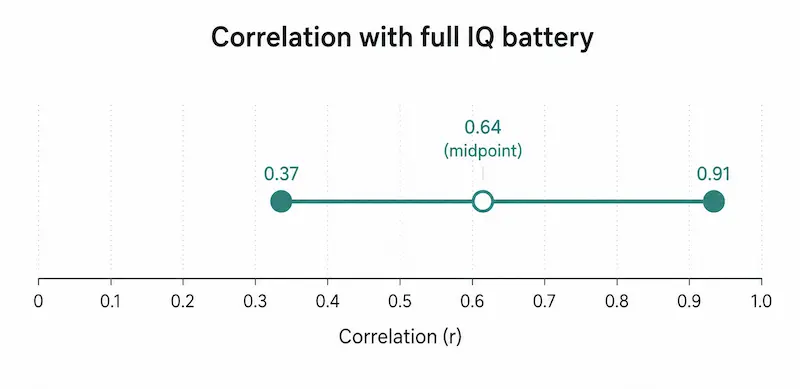
A 10-question IQ test isn't a novelty invented by online quiz sites — a genuinely validated short-form intelligence test, the Ammons Quick Test, has existed since the 1960s and has been re-validated repeatedly, with documented correlation coefficients against the full Wechsler Adult Intelligence Scale ranging from r=0.37 in early studies to as high as r=0.91 in later revalidations. That range matters: it shows short-form tests can correlate meaningfully with a full battery, but the correlation is inconsistent across studies and populations — a caveat almost every "10 question IQ test" website skips entirely while presenting its own unvalidated quiz with the same confident tone. The honest version: a well-designed 10-question test can give a rough directional estimate; it cannot replace a full battery, and most free online versions haven't published any validity data at all.
Short-form IQ testing is a real research area — it's just usually done differently than the free version
Before evaluating any specific "10 question IQ test," it's worth knowing that short-form intelligence testing has a legitimate, decades-long academic history. The Ammons Quick Test, developed in the 1960s, is a genuine example: a brief vocabulary-based intelligence estimate that researchers have repeatedly checked against full batteries. Early validation work found correlation coefficients ranging from r=0.37 to r=0.68 against several short-form intelligence measures; a later 2013 revalidation across a more diverse sample found coefficients as high as r=0.61 to r=0.91 against a range of established tests, including the Wechsler scales. One documented conversion point: a Quick Test raw score of 46 corresponded to a WAIS IQ score of 110. That spread — anywhere from a moderate r=0.37 to a strong r=0.91 depending on the study — is the single most important fact about short-form testing that most "10 question" marketing pages leave out. It shows the format can work, but how well it works varies significantly by population, administration, and the specific short-form design. A modern free quiz claiming accuracy without publishing anything like this data isn't following the same standard the legitimate research does.
How psychologists actually build a legitimate short form
Formal short-form research doesn't just chop a full test down to 10 random questions — it's built through statistical modeling. A 2023 study developing a short form of the Indonesian WAIS-IV tested 13 different short-form configurations, ranging from 2-subtest to 7-subtest versions, using regression analysis against a standardization sample of 1,745 participants to estimate Full Scale IQ from the reduced item set. The explicit purpose was screening under time constraints — not a substitute for the full assessment, but a deliberately calibrated approximation with known error margins attached to each configuration. That's the structural difference worth understanding: a legitimate short form is a statistically derived compromise, built by removing carefully chosen subtests and correcting for what's lost. A free "10 question IQ test" website, by contrast, is usually just a short quiz built for engagement, with no published regression model, no reported error margin, and no disclosed relationship to any validated instrument.
Why fewer questions means more noise, not just less time
This is the part worth internalizing before trusting any short score: in a 10-item test, each question represents roughly 10% of the total result. A single ambiguous item, a moment of inattention, or one instance of test anxiety on a timed question has a proportionally much larger effect on the final score than the same event would in a 60-to-100-item battery, where a single missed item barely moves the total. This isn't a flaw unique to any particular website — it's a mathematical property of shorter tests in general, which is exactly why professionally developed short forms lean on regression modeling and known conversion tables rather than simply awarding a raw percentage-correct score.
What a 10-question test is actually good for
None of this means a short test is worthless — it means the honest framing matters. A well-constructed 10-question format, covering a genuine spread of reasoning types (logical, spatial, numerical), can function as a rough screening tool: useful for curiosity, for noticing an unusually strong or weak result worth following up on, or as a low-stakes starting point before considering a full psychometric evaluation. What it can't reasonably claim is precision — a confident single number presented without any error range is overstating what ten items can actually support, regardless of how the results page is formatted.
How to read a result from any short test
Treat a 10-question score as a wide estimate, not a point value — a useful mental model is to picture the reported number sitting inside a considerably wider range than a full test's published margin of error, simply because there are far fewer data points behind it. If a short test result surprises you in either direction, that's a reason to try a longer, more thoroughly validated format before drawing any conclusion, not a reason to accept or reject the number outright.
This is not a diagnostic or clinical tool
No short-form test, free or otherwise, substitutes for assessment by a qualified psychologist. Treat any 10-question score as a rough, low-confidence estimate.
Sources
- Wikipedia — "Ammons Quick Test" (validation history, correlation coefficients, WAIS conversion data). https://en.wikipedia.org/wiki/Ammons_Quick_Test
- PMC — "The Development of a Short Form of the Indonesian Version of the Wechsler Adult Intelligence Scale—Fourth Edition" (regression-based short-form methodology). https://www.ncbi.nlm.nih.gov/pmc/articles/PMC10455158/
- arXiv — "Making Intelligence: Ethical Values in IQ and ML Benchmarks" (validity concepts applied to intelligence testing). https://arxiv.org/pdf/2209.00692
Frequently asked questions
Is a 10-question IQ test accurate?+
It can offer a rough directional estimate, but with far more statistical noise per item than a full battery — treat the result as a wide estimate, not a precise score.
Has a short-form IQ test ever actually been validated?+
Yes — the Ammons Quick Test, developed in the 1960s, has been re-validated multiple times, with documented correlations to the WAIS ranging from r=0.37 to r=0.91 depending on the study and population.
Why do shorter IQ tests carry more error?+
Each question represents a larger share of the total score — on a 10-item test, a single wrong or lucky answer can shift the result by roughly 10%, versus about 1-2% on a 60-plus item battery.
How do psychologists build a legitimate short-form IQ test?+
Through statistical modeling — regression equations built from a subset of subtests and validated against a full standardization sample, with a known error margin attached, rather than a simple percentage-correct score.
Should I trust a free online 10-question IQ test's result?+
Only as a rough estimate. Most free short quizzes don't publish any validity or reliability data for their specific test, unlike academically studied short forms.
What should I do if a 10-question test result surprises me?+
Take a longer, more thoroughly validated test before drawing any conclusion — a short result in either direction deserves a second look with more data points behind it.
Find out your IQ
Take the free IQ test and get your score, percentile, and a full cognitive breakdown in about 12 minutes.
Start Free Test