Machine Intelligence Test: How AI Is Actually Measured for "IQ"
- Written by
- IQCognify Editorial Team
- Reviewed for accuracy
- IQCognify Research Review Process
- Last updated
- Reading time
- 6 min
Quick answer
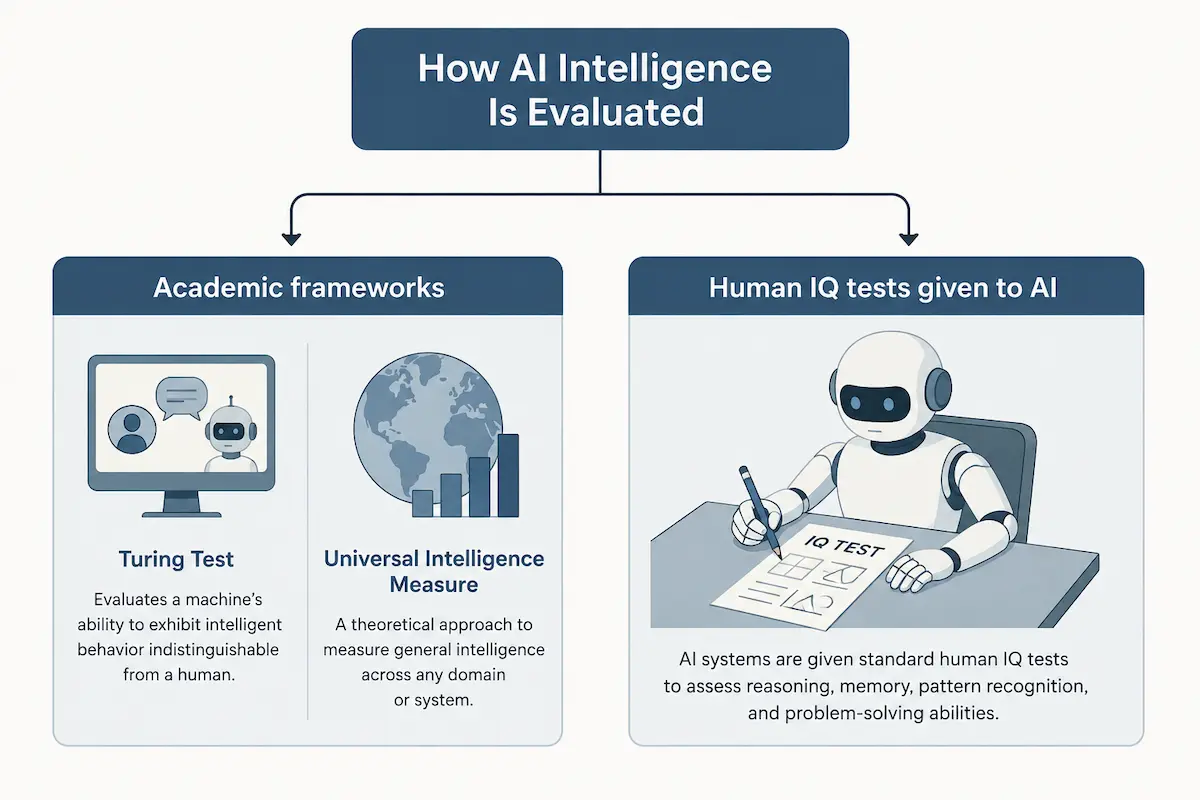
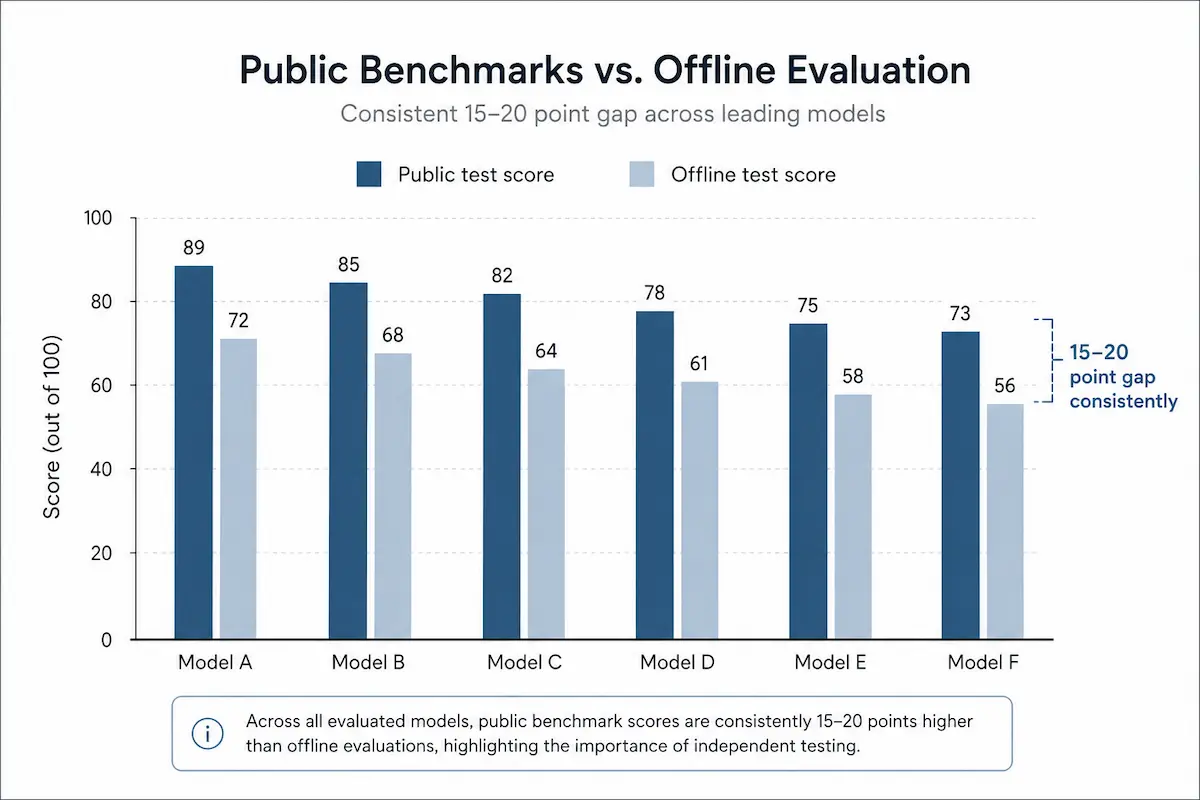
A "machine intelligence test" means one of two things: a formal academic framework for measuring AI (the Turing Test, the Legg-Hutter Universal Intelligence Measure), or — increasingly, as of 2026 — literally giving human IQ tests to AI models and reporting a score. The second approach dominates search interest, and it comes with a critical catch: scores on publicly available tests run 15-20 points higher than scores on offline, leak-resistant test sets built to prevent training-data contamination.
Two very different meanings under one search term
"Machine intelligence test" covers two genuinely different things, and most content answers only one of them. The first is a formal, decades-old academic subfield: how do you rigorously define and measure intelligence in a non-human system? The second is a much newer, more viral practice: administering an actual human IQ test — unmodified — to a large language model and reporting the resulting number as if it were comparable to a human score. Both are worth understanding, and they lead to very different conclusions about what "machine intelligence test" results actually mean.
The academic tradition, briefly
Formal attempts to measure machine intelligence predate the current AI boom by over 70 years. The most famous is Alan Turing's 1950 test, which sidesteps defining intelligence directly and instead asks whether a machine can hold a natural-language conversation indistinguishable from a human's. This approach has drawn criticism since it was proposed, since humans are prone to attributing human-like understanding to systems that are pattern-matching rather than reasoning. More mathematically rigorous alternatives followed decades later. Legg and Hutter's widely cited 2007 framework proposed that a valid measure of intelligence should be applicable across very different kinds of agents (not just humans), account for the capacity to learn and adapt to new situations, avoid bias toward any particular culture or species, remain stable as the underlying technology changes, and be specified precisely enough to leave no room for interpretation. That checklist is useful for judging any claimed measure of machine intelligence — including the human-IQ-test approach that dominates search results and headlines today, which fails several of these criteria at once, as the contamination problem below makes clear.
Why researchers reach for human IQ tests anyway
Given that mismatch, it's worth asking why IQ tests get used on AI at all. The practical answer: IQ tests cover many categories at once — verbal reasoning, logic, pattern completion — so a single test exercises multiple AI capabilities simultaneously, including knowledge representation, working memory-adjacent processing, and language handling. Improving performance across an IQ battery tends to require genuine advances across several of those areas at once, not just one narrow skill. In other words, IQ tests aren't the theoretically ideal instrument by the Legg-Hutter criteria — they're a convenient, standardized, human-comparable stand-in that happens to stress multiple capabilities at the same time, which is precisely why they were adopted for this purpose despite not being designed for it.
The 2026 trend: AI models scoring "genius-level" IQ, and why that's misleading on its own
As of mid-2026, independent trackers — most prominently TrackingAI.org — administer weekly IQ-style tests to frontier AI models using two distinct test sources: publicly available instruments like the Mensa Norway matrix-reasoning test, and offline, leak-resistant test sets specifically constructed to avoid appearing in any model's training data. The results diverge sharply depending on which set is used. On the Mensa Norway test, current top scores place several frontier models above 140 — solidly above the 99.7th percentile of the human population, in the range this site covers in detail under genius-level IQ. That headline number is the one that gets repeated. The more important number sits right next to it: on leak-resistant offline assessments designed specifically to eliminate the possibility that a model encountered similar problems during training, the same models' scores drop substantially — often into the low-to-mid 120s rather than the 140s reported on public tests.
Why the gap exists, and why it matters
The gap isn't measurement error — it's a contamination problem. Any publicly posted test, with answer patterns discoverable online, risks appearing somewhere in a model's training data, directly or indirectly. A model that has effectively "seen" a test before will score higher on it regardless of whether it's actually reasoning through the problem or reproducing a memorized pattern. Offline test sets exist precisely to strip that advantage out, which is why researchers who track this consistently treat offline scores as the more trustworthy baseline, even though they produce the less impressive headline. This has a genuine structural parallel on the human side of this site: test anxiety can shift a real human score by a measurable amount, not because the person's underlying ability changed, but because the testing conditions distorted the measurement. Data contamination does the same thing to a machine score — the number moves, but not because the thing it's supposed to measure actually changed. This is the single most important fact to know before reading any "AI scores higher than 99% of humans" headline: ask which test set produced the number, because the answer changes it by double digits.
Does a high score mean the AI is actually more "intelligent"?
Not necessarily, and this is where the academic tradition and the viral-headline tradition genuinely disagree. By the Legg-Hutter-style criteria above, a valid intelligence measure should generalize across many kinds of tasks and resist gaming — exactly the property a leaked, publicly available test violates. A model that scores well on a memorized-adjacent test hasn't necessarily demonstrated the general reasoning ability an IQ score is supposed to represent in a human. This connects to a broader point covered on what IQ actually is: even for humans, a single test score is a proxy for a broader construct, not the construct itself — and that gap between proxy and construct only widens when the test-taker is a machine with a training process a human never goes through.
What this means if you're comparing AI models
If you're actually trying to judge which AI system reasons best, an IQ-style score is a weak signal in isolation. It's more informative when paired with contamination-resistant benchmarks purpose-built for AI — tests explicitly designed, similar in spirit to Legg and Hutter's original criteria, to resist memorization and reward genuine generalization to novel problems. Treat any single IQ number, human or machine, the way this site recommends treating one human score taken under bad conditions — informative, but incomplete without knowing exactly how it was produced.
This is not a technical benchmarking guide
Specific model rankings shift frequently as new versions ship and new test sets are built. Treat any single reported number, for a human or a machine, as a snapshot rather than a fixed fact.
Sources
- Legg, S., & Hutter, M. (2007). "Universal Intelligence: A Definition of Machine Intelligence." Minds and Machines, 17(4), 391–444. — https://doi.org/10.1007/s11023-007-9079-x
- Turing, A. M. (1950). "Computing Machinery and Intelligence." Mind, 59(236), 433–460. — https://doi.org/10.1093/mind/LIX.236.433
- Hendrycks, D., et al. (2021). "Measuring Massive Multitask Language Understanding." International Conference on Learning Representations. — https://arxiv.org/abs/2009.03300
- TrackingAI.org (2026). "Tracking AI Model IQ Scores: Public vs. Offline Test Comparisons." — research tracking resource, cited for current 2026 score data.
- Deary, I. J. (2020). Intelligence: A Very Short Introduction (2nd ed.). Oxford University Press.
Frequently asked questions
What is a machine intelligence test?+
It can refer to a formal academic framework for measuring AI capability, like the Turing Test or the Legg-Hutter Universal Intelligence Measure, or, more commonly today, the practice of giving an AI model an actual human IQ test and reporting the score.
Can you really give an AI an IQ test?+
Yes, and it's now common practice among AI trackers — but the same model can score very differently depending on whether the test is publicly available and possibly present in its training data, or an offline set built specifically to resist that contamination.
Why do AI IQ scores vary so much between public and offline tests?+
Publicly posted tests risk appearing in a model's training data, inflating scores through pattern memorization rather than genuine reasoning. Offline, leak-resistant tests are built specifically to prevent that advantage, which is why the same model can score 15-20 points lower on them.
Is a high AI IQ score proof of real intelligence?+
Not on its own. A valid intelligence measure should generalize across novel tasks and resist gaming — properties a leaked public test can violate. Offline scores are generally considered the more trustworthy figure for this reason.
What was the first formal machine intelligence test?+
The Turing Test, proposed by Alan Turing in 1950, judges intelligence by whether a machine's conversation is indistinguishable from a human's in natural-language exchange.
Are IQ tests even designed to measure machine intelligence?+
No. They were built for humans, and researchers who study this directly note IQ tests can't serve as a true standard for machine intelligence, even though they remain a convenient benchmark that happens to exercise multiple AI capabilities at once.
Why do researchers still use IQ tests on AI if they weren't designed for it?+
Because a single IQ battery exercises several distinct capabilities at once — reasoning, pattern recognition, language processing — making it a convenient, standardized proxy even though it fails several of the formal criteria for a genuinely valid machine intelligence measure.
Find out your IQ
Take the free IQ test and get your score, percentile, and a full cognitive breakdown in about 12 minutes.
Start Free Test