
The Negative Flynn Effect: Are IQ Scores Actually Falling?
- Written by
- IQCognify Editorial Team
- Reviewed for accuracy
- IQCognify Research Review Process
- Last updated
- Reading time
- 7 min
Quick answer
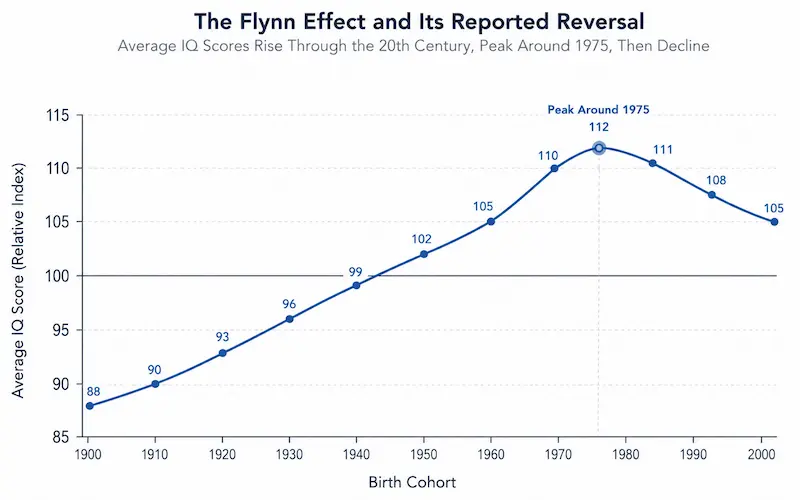
The negative Flynn effect refers to IQ score declines observed in several countries since the mid-1970s birth cohorts, reversing a century-long rise. The strongest evidence — from within-family data in Norway — shows the decline is environmental, not genetic.
First, the rise that has to be explained
The starting point is the Flynn effect itself: across the twentieth century, people scored higher and higher on the same IQ tests, at a rate of roughly three points per decade. The gains were largest on abstract, fluid-reasoning tests — the culture-reduced ones supposedly least sensitive to schooling — which is exactly the opposite of what most people would have guessed. Nobody thinks the human genome improved over three generations; evolution does not move that fast. So the rise was always, necessarily, environmental — better nutrition, smaller families, more and longer schooling, more cognitively demanding work and leisure. James Flynn himself, after whom the effect is named, spent much of his career arguing that the gains reflected a shift toward more abstract, scientific "spectacles" through which modern populations learn to view problems — not a change in raw brainpower so much as a change in the kinds of mental habits schooling and modern life reward.
Then the scores turned around
From the 1990s onward, researchers in several countries began reporting that the gains had slowed, stalled, or reversed. Early reports came from Scandinavia and parts of continental Europe, and for years the finding was treated cautiously — a possible ceiling effect, a sampling quirk, a test-specific artefact. What changed the conversation was a data source almost uniquely suited to answering the question properly. Norway conscripts nearly all young men for military service and has done for decades, administering a cognitive test to each of them and recording the results in a centralised registry. Critically, that registry also records family relationships, because conscription records can be linked to national population data. That combination — near-universal testing, plus known sibling relationships, sustained over half a century — is not something most countries have. Bratsberg and Rogeberg, writing in the Proceedings of the National Academy of Sciences in 2018, used those records to show that Norwegian scores peaked for men born around 1975 and have declined since — by roughly 0.2 points per year, or roughly 7 points across the cohorts they examined. That is not a small effect. Over several decades it is comparable in magnitude, in the opposite direction, to a meaningful slice of the original Flynn rise.
This is about raw scores, not your IQ number
The reversal is measured in raw performance. Because tests are periodically re-normed so the population average is always reset to 100, a declining raw trend does not change anyone's reported IQ. The number on a report is a rank against a current sample, not an absolute quantity — as the percentile logic makes clear.
The finding that rules out the scary explanations
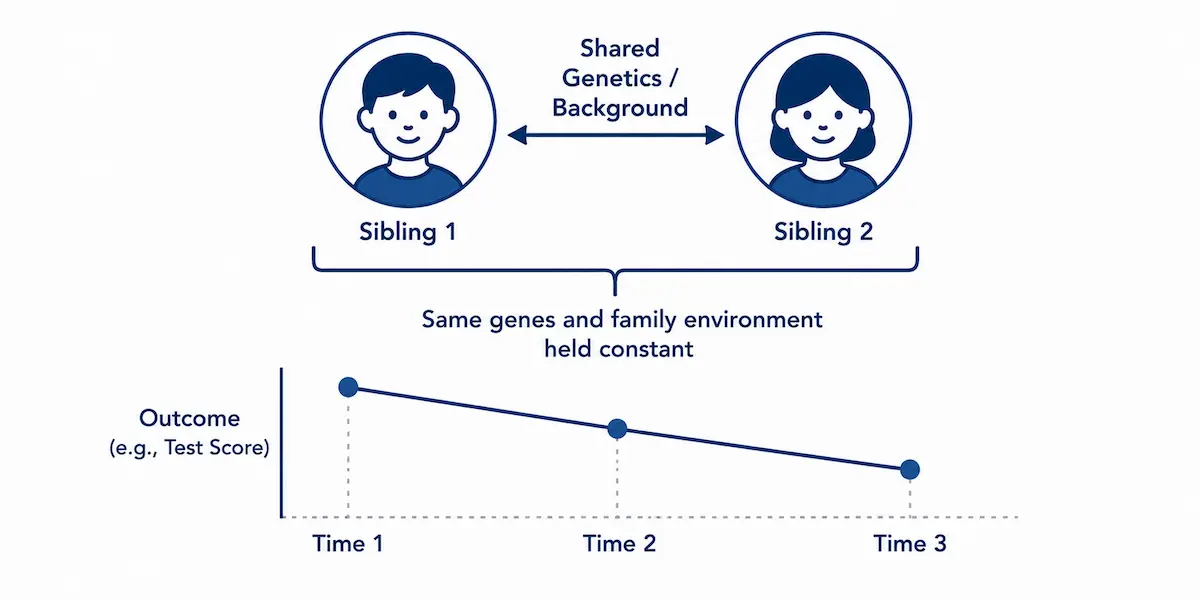
Because the data linked brothers, Bratsberg and Rogeberg could measure the trend within families — comparing younger brothers to older ones, raised by the same parents, in the same household, sharing roughly the same genetic stock. The decline appears there too, at almost the same magnitude as the between-family decline. This is the methodologically decisive part of the study, and it is worth being explicit about why. Brothers share their parents, their ancestry and their broad social background. A decline that shows up between brothers cannot be caused by changing genetic stock in the population, and it cannot be caused by immigration changing who is being tested — both of those would only affect the picture at the population level, not within a single family. Something in the environment shared across Norwegian childhoods changed between the older and younger brother's early years, and it was enough to move scores down by a measurable amount. This is the same lesson that runs through the genetics of intelligence more generally: a change in a population average is a fact about conditions, not a verdict on innate capacity. It's also worth noting this cuts against a common misreading of the g factor — a shifting population trend doesn't change what g measures within a testing sample, it changes the conditions producing the scores that feed into it.
Is this happening everywhere?
No, and this matters for how seriously to take the finding. The picture across countries is genuinely mixed. Norway, Denmark, Finland and the UK have reported evidence of stalling or reversal in various datasets. France has shown a decline on some measures. Meanwhile, a number of developing countries are still in the earlier, rising phase of their own Flynn effect, as education access and nutrition continue to improve in populations that started from a different baseline. A 2014 meta-analysis by Trahan and colleagues, reviewing decades of Flynn effect literature broadly, found the overall historical gain was smaller than Flynn's original estimate but still real and still substantial across the tests and countries studied. So "the negative Flynn effect" is best understood as a documented phenomenon in some developed nations with mature, long-running testing infrastructure — not a global law. The Norwegian data is the strongest single case because of its data quality, not because Norway is uniquely representative of the whole world.
What is actually causing the decline?
The within-family result tells us the cause is environmental. It does not tell us which environmental factor, and the candidates are plausible but not proven — Bratsberg and Rogeberg themselves were careful to say their data could establish that the cause was environmental without being able to identify which environmental change was responsible.
- Changes in education — what is taught, how, and how much abstract reasoning it demands — is the leading suspect. Some researchers point to shifts away from certain kinds of abstract problem-solving instruction toward more applied or test-specific preparation.
- Shifts in how people spend attention, including the move from long-form text to feeds and short video, though this is more asserted than demonstrated with the same rigour as the Norwegian data itself.
- Nutrition, health and demographic factors such as older parental age, whose effects are real but modest, and unlikely to explain the full magnitude of the Norwegian decline on their own.
- Test-taking motivation and familiarity, which can move measured scores without touching underlying ability — a factor worth weighing alongside test anxiety's similar effect on individual scores, though this would need to have shifted systematically across an entire generation of conscripts to explain a population-level trend.
No single one of these has been isolated as the cause with the same clarity that the within-family design established environment as a cause. This is a genuinely open research question, not a solved one — treat any confident single-cause explanation with some scepticism.
How worried should you be?
Less than the headlines suggest. "People are getting dumber" treats IQ as a fixed essence that is draining away. The evidence points the other way: scores track environments, environments change, and a few tenths of a point per year in one country's conscript data is not a civilisation in cognitive freefall. It is also worth situating the size of the effect. Bratsberg and Rogeberg's estimated Norwegian decline, projected across a generation, is real but modest relative to the century of gains that preceded it — this is a partial retracement, observed so far in a handful of countries, not an erasure of the twentieth century's gains. The measured, defensible reading: the same environmental leverage that pushed scores up for a century can push them down, the Norwegian data show it is doing so there — and that is a reason to pay attention to educational and developmental conditions, not a reason to believe intelligence itself is decaying.
Sources
- Bratsberg, B., & Rogeberg, O. (2018). "Flynn effect and its reversal are both environmentally caused." Proceedings of the National Academy of Sciences, 115(26), 6674–6678. — https://doi.org/10.1073/pnas.1718793115
- Flynn, J. R. (2007). What Is Intelligence? Beyond the Flynn Effect. Cambridge University Press.
- Trahan, L. H., Stuebing, K. K., Fletcher, J. M., & Hiscock, M. (2014). "The Flynn effect: A meta-analysis." Psychological Bulletin, 140(5), 1332–1360. — https://doi.org/10.1037/a0037173
- Dutton, E., van der Linden, D., & Lynn, R. (2016). "The negative Flynn Effect: A systematic literature review." Intelligence, 59, 163–169. — https://doi.org/10.1016/j.intell.2016.10.002
- Deary, I. J. (2020). Intelligence: A Very Short Introduction (2nd ed.). Oxford University Press.
- Neisser, U., et al. (1996). "Intelligence: Knowns and Unknowns." American Psychologist, 51(2). APA.
Frequently asked questions
Are IQ scores really falling?+
Raw scores have declined in several countries since around the mid-1970s birth cohorts, reversing the long twentieth-century rise. The clearest evidence is from Norway, where Bratsberg and Rogeberg (2018) found scores peaked for men born around 1975 and have fallen roughly 0.2 points per year since. In other countries the trend has stalled or is still rising, so it is not a universal decline.
What is the negative or reverse Flynn effect?+
It is the name for the reversal of the Flynn effect — the century-long rise in IQ test performance of about three points per decade. In some populations that rise has stopped and turned into a gradual fall in raw scores.
Does the negative Flynn effect mean people are getting less intelligent?+
Not in any fixed, innate sense. The best evidence shows the decline is environmental rather than genetic, because it appears within families — between brothers who share ancestry and background. It reflects changing conditions such as education and lifestyle, not a loss of underlying human capacity.
How do we know the decline is environmental and not genetic?+
Because it shows up within families. Bratsberg and Rogeberg (2018) compared brothers born a few years apart and found the same downward trend. Brothers share their parents and ancestry, so a decline between them cannot be caused by changing genetics or immigration — it must come from the environment.
Is the negative Flynn effect happening in every country?+
No. It has been documented most clearly in Norway, and reported in various forms in Denmark, Finland, France and the UK. Many developing countries are still in an earlier rising phase of their own Flynn effect as education and living standards improve. It is a real but geographically uneven phenomenon.
If scores are falling, why is the average IQ still 100?+
Because IQ tests are periodically re-normed so the population average is always reset to 100. The Flynn effect and its reversal are measured in raw performance, not in the reported IQ number. Your IQ is a rank against a current sample, so a shifting raw trend does not change it.
What is causing the reversal?+
The evidence establishes that the cause is environmental but not which factor. Leading candidates include changes in education, shifts in how people read and spend attention, and demographic factors such as parental age. No single cause has been demonstrated, and confident single-cause explanations go beyond what the data support.
Find out your IQ
Take the free IQ test and get your score, percentile, and a full cognitive breakdown in about 12 minutes.
Start Free Test