What Was Nikola Tesla's IQ? The 160–310 Claims vs the Evidence
- Written by
- IQCognify Editorial Team
- Reviewed for accuracy
- IQCognify Research Review Process
- Last updated
- Reading time
- 11 min
Quick answer
Nikola Tesla's IQ is unknown. There is no record that he ever took an intelligence test: the first one was published in 1905, when he was in his late forties, and there is no record of him sitting one later. The figures you see online — 160, 200, "160 to 310" — have no traceable source, and 310 is not even possible on a real IQ scale. What we do have is a documented record: top marks at university in Graz, a set of 1888 patents that helped bring alternating current into homes and factories, and at least 311 patents across 27 countries.
What was Nikola Tesla's IQ?
Short answer
Nobody knows. There is no record Tesla ever took an IQ test, and none of the numbers online — 160, 200 or 310 — comes from a test, a study or Tesla himself.
Search for Tesla's IQ and you will find confident numbers: 160, 180, 200, and the most viral of all, "between 160 and 310". Some posts add that his IQ was "way higher than Einstein's". None of these pages names a test, a date, a psychologist or a published study. They cite each other.
The honest answer has two parts. First, Tesla's IQ is unknown and cannot now be measured. Second, his documented record — his university grades, his patents and the machines that still run on his ideas — tells us far more about his mind than an invented number could.
Did Tesla ever take an IQ test?
No, and for most of his life he could not have. Tesla was born on 10 July 1856. The first practical intelligence test, the Binet–Simon scale, was published in France in 1905, when Tesla was 49 and already famous. Early tests were designed for schoolchildren, and adult testing only became common decades later.
There is no record of Tesla taking any of these tests before his death in New York on 7 January 1943. His papers are held by the Nikola Tesla Museum in Belgrade, and none of the biographical material we reviewed mentions an IQ score.
Historians have tried to estimate the IQs of famous people from biographies. The best-known attempt, by psychologist Catharine Cox in 1926, covered about 300 eminent people born between 1450 and 1850. Tesla was born in 1856, so he was not in it — the same reason Einstein was left out. No comparable study of Tesla has been published.
What was Einstein's IQ? — The same untraceable 160 — and the older magazine figures it replaced.Where do the 160 and 310 figures come from?
We could not find an original source for any of the numbers. The pattern is the same one seen with Einstein and Stephen Hawking: a round "genius" number is attached to a famous scientist, and websites copy it from each other until it looks established.
The range "160 to 310" spread mainly through social media posts and list articles. The lower end, 160, matches the figure popularly given to Einstein. The upper end, 310, has no explanation at all. Some IQ test sellers offer a "sober" estimate of 160 to 180, but this is reasoning from Tesla's inventions, not a measurement.
| Claim | Where you see it | Evidence | Verdict |
|---|---|---|---|
| IQ of 160 | IQ test sites and lists | No test or study or named source | Unverified estimate |
| IQ of 160 to 180 | Some IQ test sellers | Reasoning from his inventions only | Guess |
| IQ of about 200 | Quiz and trivia sites | No source given | Unsourced |
| IQ of 160 to 310 | Social media and listicles | No source given | Unsourced range |
| IQ of 310 | Viral posts | 14 standard deviations above average | Impossible on a real IQ scale |
| Higher IQ than Einstein | Viral threads | Neither man took a test | Cannot be answered |
Why an IQ of 310 is impossible
Modern IQ scores are not points on a ruler. They are a ranking: a score shows how far someone sits from the average of people their age, measured in standard deviations. On today's tests the average is 100 and one standard deviation is 15 points.
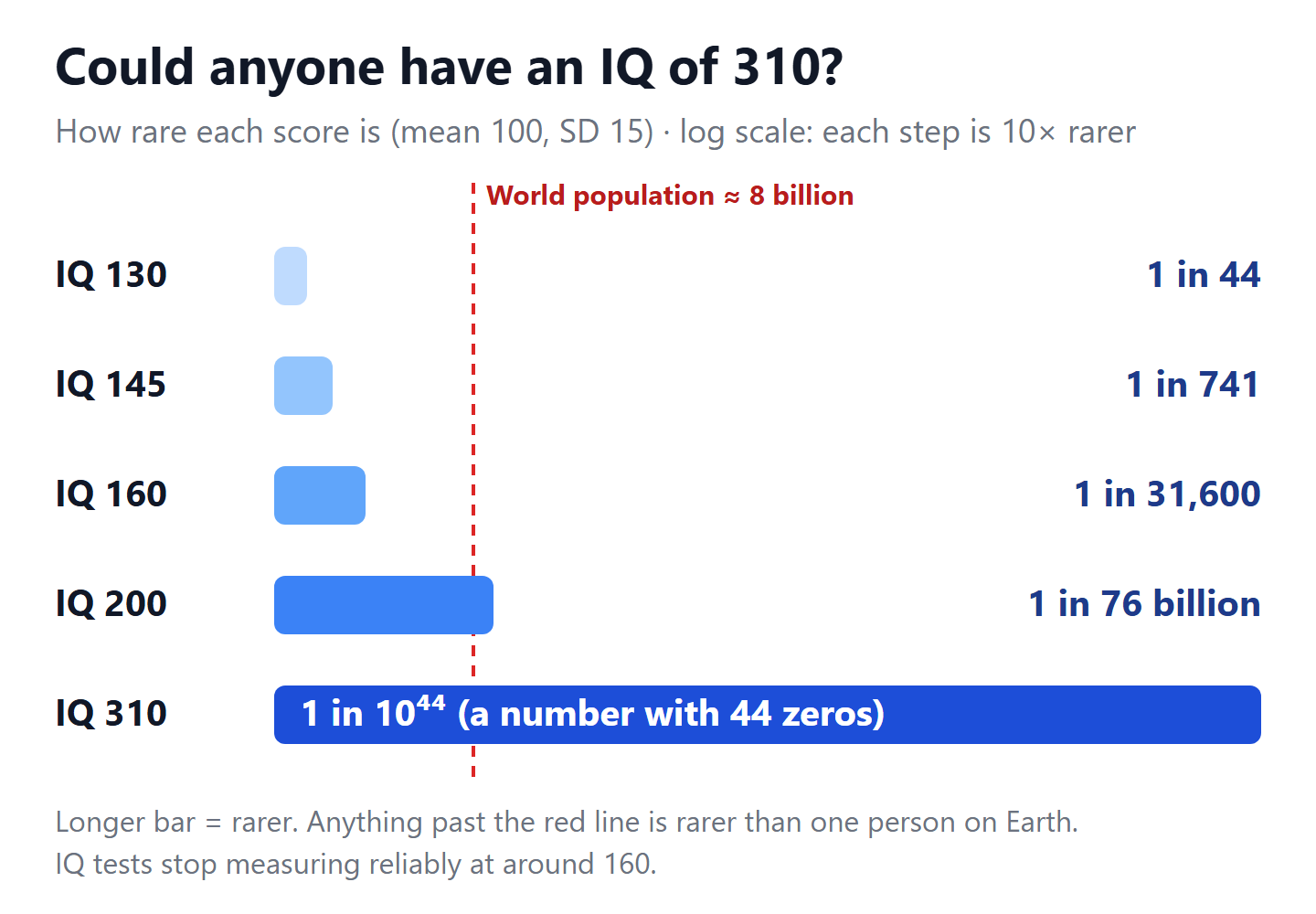
That makes it easy to check any claimed score. An IQ of 160 is four standard deviations above average, about 1 in 31,600 people. An IQ of 200 is six and two-thirds standard deviations above, about 1 in 76 billion — roughly nine times the number of people alive today. An IQ of 310 is fourteen standard deviations above average. Statistically that is about 1 in 10 to the power of 44, a number with 44 zeros.
| IQ score | Standard deviations above average | How rare |
|---|---|---|
| 130 | 2 | About 1 in 44 |
| 145 | 3 | About 1 in 741 |
| 160 | 4 | About 1 in 32 thousand |
| 180 | 5.3 | About 1 in 21 million |
| 200 | 6.7 | About 1 in 76 billion |
| 310 | 14 | About 1 in 10 to the power of 44 |
There is a second problem. A test can only rank people against the sample it was built on, usually a few thousand people. Most tests stop measuring reliably somewhere around 160, because the sample contains almost nobody beyond that point. A score of 310 would need a comparison group far larger than the human race. It is not a high score. It is not a score at all.
IQ percentile calculator — See exactly what any IQ score means as a percentile and a rarity.What Tesla said about his own mind
Much of what people repeat about Tesla's mind comes from one source: Tesla himself. In 1919 he published a short memoir, My Inventions, as a series of articles in Electrical Experimenter magazine. In it he describes an unusual ability to picture machines in full detail.
I needed no models, drawings or experiments. I could picture them all as real in my mind.— Nikola Tesla, My Inventions (1919), Chapter I
He also wrote that at school he "often won the professor's praise for rapid calculation", that by his mid-twenties "I knew entire books by heart, word for word", and that he "had studied a dozen languages". These are striking claims — but they are his own account, written when he was 62, about events decades earlier. Nobody tested them at the time.
Did Tesla have a photographic memory?
Not in any tested sense. Tesla's memory claims come from his own memoir, and nobody measured them. Research on so-called photographic memory has never found an adult who can recall a page like a photograph. The table below grades each of the famous claims by how strong the evidence is.
| Ability or trait | Where the claim comes from | Evidence level |
|---|---|---|
| Designed and tested machines in his mind | His 1919 memoir | Self-reported |
| Knew entire books by heart | His 1919 memoir | Self-reported and never tested |
| Rapid mental calculation | His memoir (school years) | Indirectly supported by his Graz grades |
| Studied a dozen languages | His 1919 memoir | Self-reported; studied is not the same as fluent |
| Photographic memory | Later retellings | Legend; never tested |
| Fixation on the number three | Later biographies and articles | Widely reported but mostly second-hand |
| Obsessive-compulsive disorder | Modern writers | A retrospective label and not a diagnosis |
Tesla at school: top grades, then no degree
Tesla's school record is the closest thing we have to a measured result, and it is genuinely impressive — for a while. In 1875 he enrolled at the Imperial-Royal Technical College in Graz, Austria (today TU Graz), on a military scholarship. According to the university's own archive, with one exception he achieved the grade of "excellent" in every exam he took. The exception, a mathematics exam on the congruence of numbers, was graded "good".
Then his studies fell apart. At the end of his second year the military authorities withdrew his scholarship, citing an "unjustified interruption of his studies". He took no exams in his third year, and his student record says he was struck off for not paying the teaching fee for the first semester of 1877/78. He left Graz in late 1878 without a degree.
In 1880 he went to Prague and attended lectures at the university as an auditor, but he was not enrolled and received no marks. He never completed a university degree. His later degrees were honorary: Columbia University and Yale both honoured him in June 1894, and TU Graz itself gave him an honorary doctorate in 1937.
What this tells us
Excellent grades in demanding engineering and mathematics courses are real evidence of strong ability. They do not translate into a specific IQ number — and the same record shows that ability alone did not carry him through.
Tesla's record: patents and inventions
Tesla's achievements are well documented, and they are the strongest evidence of his ability. The Nikola Tesla Museum in Belgrade, which holds his archive, counts 112 US patents and at least 199 more in 26 other countries — at least 311 patents in 27 countries. Many of the foreign patents protect the same inventions in different markets, so the number of distinct inventions is smaller.
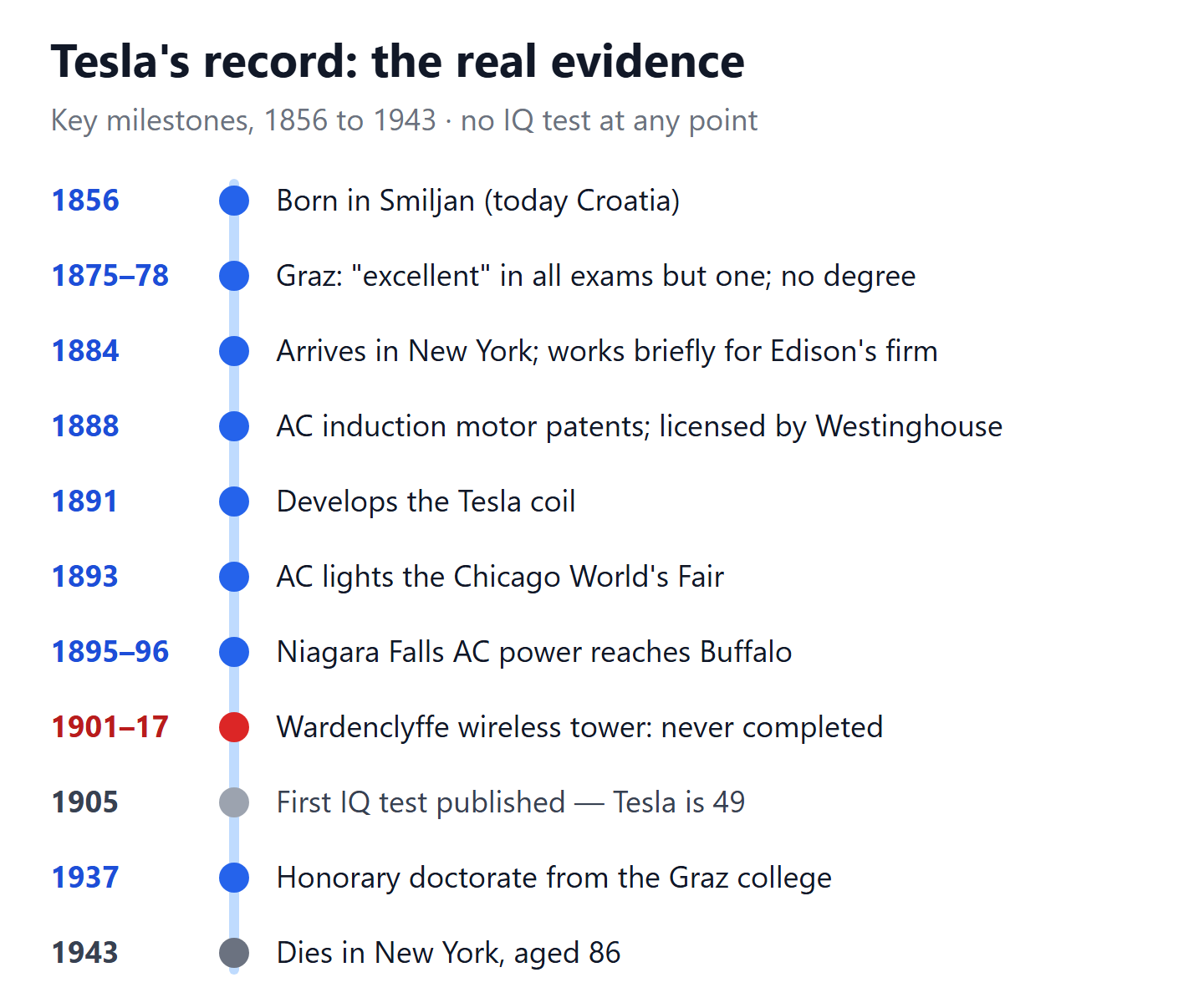
- 1884: arrived in New York and worked briefly for Thomas Edison's company before going his own way.
- 1888: granted US patents 381,968 and 382,280 for an alternating-current induction motor and power transmission system. Westinghouse licensed them the same year.
- 1891: developed the Tesla coil, a resonant transformer used in early radio research and still used in demonstrations today.
- 1893: Westinghouse lit the Chicago World's Fair with alternating current, showcasing Tesla's system.
- 1895–1896: the Niagara Falls power plant began supplying AC power that reached Buffalo in 1896, using his polyphase design.
- 1899–1917: experiments in Colorado Springs and the Wardenclyffe tower in New York, aimed at wireless power — a project that ran out of money and was never completed.
- 1960: the international unit of magnetic flux density was named the tesla in his honour.
The record also includes failures, unfinished projects and money troubles. Tesla died in a New York hotel room in 1943, far from wealthy. That mix of brilliance and difficulty is part of why his story attracts exaggerated numbers.
Tesla vs Einstein: who had the higher IQ?
This is one of the most searched questions about Tesla, and it has no answer. Neither man is known to have taken an IQ test, so there are no scores to compare. Viral posts claiming Tesla's IQ was "way higher than Einstein's" are comparing one unsourced number with another.
| Fact | Nikola Tesla | Albert Einstein |
|---|---|---|
| Born | 1856 | 1879 |
| Published IQ score | None | None |
| Figure quoted online | 160 to 310 | 160 |
| In Cox's 1926 study | No (born after 1850) | No (born after 1850) |
| Best evidence of ability | Patents and working AC systems | Published physics papers |
They also excelled at different things. Tesla was an inventor and engineer who built working machines. Einstein was a theoretical physicist who changed how we understand space, time and energy. A single IQ number could not capture either kind of achievement.
Who has the highest IQ ever recorded? — The verified records — and the famous claims that don't hold up.Does IQ explain what Tesla achieved?
Only partly. Psychologist Dean Keith Simonton, who reviewed decades of research estimating the intelligence of eminent people from historical records, found that estimated intelligence is related to eminence — but only modestly (Simonton, 2009). Most of the difference in eminence comes from other things: creativity, persistence, training, timing and opportunity.
Tesla's life fits that picture. His university grades show strong ability, but he left without a degree. His AC patents arrived at exactly the moment the electrical industry needed them, and they had a powerful backer in Westinghouse. His later projects, just as ambitious, failed for lack of money. What made him remarkable was what he built, not a number nobody measured.
Does IQ predict success? — What decades of research say about IQ, careers and achievement.Take the free IQ test — 27 questions, about 12 minutes, with an instant score and a breakdown of your abilities.Sources
- Tesla, N. (1919). My Inventions. Electrical Experimenter, February–June and October 1919. Full text on Wikisource: https://en.wikisource.org/wiki/My_Inventions
- TU Graz. Tesla, Nikola (US) und die Technik in Graz (honorary doctorate, 1937). https://www.tugraz.at/en/news/article/tesla-nikola-us-und-die-technik-in-graz
- TU Graz. Nikola Tesla's time at TU Graz (university archive blog). https://www.tugraz.at/en/news/tu-graz-blog/detail/article/nikola-tesla-s-time-at-tu-graz0
- Nikola Tesla Museum, Belgrade. Tesla's patents. https://tesla-museum.org
- Tesla, N. US Patent 381,968, Electro-Magnetic Motor, and US Patent 382,280, Electrical Transmission of Power, both granted 1 May 1888.
- Columbia University Libraries (2025). Nikola Tesla and Seth Low. https://blogs.library.columbia.edu/rbml/2025/03/12/nikola-tesla-and-seth-low
- Encyclopaedia Britannica. Nikola Tesla. https://www.britannica.com/biography/Nikola-Tesla
- Binet, A., & Simon, T. (1905). Méthodes nouvelles pour le diagnostic du niveau intellectuel des anormaux. L'Année psychologique, 11, 191–244.
- Cox, C. M. (1926). Genetic Studies of Genius, Vol. II: The Early Mental Traits of Three Hundred Geniuses. Stanford University Press.
- Simonton, D. K. (2009). The "Other IQ": Historiometric assessments of intelligence and related constructs. Review of General Psychology, 13(4), 315–326. https://doi.org/10.1037/a0017141
Frequently asked questions
What was Nikola Tesla's IQ?+
It is unknown. There is no record Tesla took an IQ test — the first one was published in 1905, when he was 49 — and there is no record of a score. Figures such as 160, 200 or "160 to 310" have no traceable source.
Is Nikola Tesla's IQ really 310?+
No. An IQ of 310 would be 14 standard deviations above average, rarer than one person in a number with 44 zeros. No IQ test can measure anything like it, and no source for the figure exists.
Did Nikola Tesla ever take an IQ test?+
There is no record that he did. Intelligence tests were invented in 1905, when Tesla was 49, and early tests were designed for children. He was also born too late to be included in Catharine Cox's 1926 historical estimates.
Who had a higher IQ, Tesla or Einstein?+
Nobody can say. Neither man is known to have taken an IQ test, so any comparison sets one unsourced number against another. Tesla was an inventor who built working machines, and Einstein a theoretical physicist; their achievements are the real evidence.
Did Nikola Tesla have a photographic memory?+
That is a legend. Tesla wrote in his 1919 memoir that he knew "entire books by heart, word for word" and could picture machines in full detail, but his memory was never tested, and true photographic memory has not been demonstrated in research.
How many languages did Tesla speak?+
Tesla wrote that he "had studied a dozen languages". Studying a language is not the same as speaking it fluently, and the exact list of languages he spoke well is not documented. The often-quoted figure of eight languages comes from later biographies, not from Tesla himself.
How many patents did Nikola Tesla have?+
The Nikola Tesla Museum in Belgrade counts 112 US patents and at least 311 patents across 27 countries. Many foreign patents protect the same inventions, so the number of separate inventions is lower.
Did Nikola Tesla graduate from university?+
No. He earned "excellent" in all but one of his exams at the technical college in Graz, but lost his scholarship and was struck off over unpaid fees in 1878. He later audited lectures in Prague without enrolling. His degrees from Columbia, Yale and TU Graz were honorary.
Find out your IQ
Take the free IQ test and get your score, percentile, and a full cognitive breakdown in about 12 minutes.
Start Free Test