
Photographic Memory: Is It Real? What the Research Shows
- Written by
- IQCognify Editorial Team
- Reviewed for accuracy
- IQCognify Research Review Process
- Last updated
- Reading time
- 15 min
Quick answer
A photographic memory — the ability to take a mental snapshot of a page and read it back later, word for word — has never been demonstrated in a single verified adult. What does exist is rarer and stranger: brief eidetic afterimages in a small minority of children, a handful of people who remember almost every day of their lives, and memory champions who can learn a shuffled deck of cards in minutes. None of them works like a camera, and none of them requires a high IQ.
Is photographic memory real?
Short answer
Not in the way most people mean it. No one has been shown, under controlled conditions, to store a page or a scene as an exact image and read details back from it later. Researchers who spent decades looking — including a 1979 newspaper screening titled “None in a million” — failed to find a single convincing adult case.
The phrase is used loosely. People say someone has a photographic memory when they remember names effortlessly, quote books, or ace exams after one read-through. Those people exist, and their memories are genuinely excellent. But when psychologists test the literal claim — that the memory is an image you can inspect like a photograph — it falls apart.
The test is simple in principle. If you truly held a photograph of a page in your mind, you could read it backwards as easily as forwards, or report the fourth word of the ninth line on request. Good memorisers cannot do this, because they are not reading an image. They are rebuilding the page from meaning, structure and practised cues — the same way everyone remembers, only better.
That is the key idea behind the rest of this article: memory is a reconstruction, not a recording. In a national US survey, 63% of people agreed that “human memory works like a video camera” (Simons & Chabris, 2011). Fifty years of memory research says the opposite.
Photographic memory vs eidetic memory: what is the difference?
The two terms are often swapped, but in research they mean different things. Eidetic memory (or eidetic imagery) is a measured phenomenon. Photographic memory is a popular idea.
| Eidetic imagery | “Photographic memory” | |
|---|---|---|
| What it is | A vivid visual image that persists briefly after a picture is removed | The idea of storing any page or scene as an exact, permanent image |
| How long it lasts | Seconds to a few minutes, then it fades | Supposedly indefinitely |
| Who has it | A small minority of children; virtually absent in adults (Haber, 1979) | No verified case |
| How accurate it is | Vivid, but not perfectly accurate | Supposedly exact |
| Status in research | Studied since the early 1900s; real but rare and limited | Not supported by evidence |
In a classic eidetic test, a child looks at a detailed picture for about 30 seconds. The picture is removed and the child keeps looking at the blank surface, describing what they still “see” — in the present tense, as if the image were in front of them, and moving their eyes to different parts of it. Their descriptions are impressive, but rarely perfect.
Ralph Haber, who reviewed twenty years of eidetic research in 1979, concluded that eidetic images “are only available to a small percentage of children 6–12 years old, and are virtually nonexistent in adults.” Popular estimates of how small that percentage is vary between reviews — figures from about 2% to 15% circulate — so treat any single number with caution.
Eidetic memory, hyperthymesia, memory athletes and savants compared
When someone is described as having a photographic memory, they almost always fit one of five real categories instead. This table separates them, because most articles on the topic blur them together.
| Type | What it is | How common | Trainable? | Key evidence |
|---|---|---|---|---|
| Eidetic imagery | A brief visual afterimage of a picture | Small minority of children; very rare in adults | No | Haber (1979) |
| Hyperthymesia (HSAM) | Recall of almost every day of one's own life, often by date | Extremely rare; only a small number of confirmed cases | No | Parker, Cahill & McGaugh (2006); LePort et al. (2012) |
| Memory athletes | Fast memorisation of cards, digits or names using mental techniques | Thousands of competitors | Yes | Maguire et al. (2003); Dresler et al. (2017) |
| Savant memory | Extraordinary memory within a narrow area, alongside a developmental condition or brain injury | Rare | No | Treffert (2009) |
| Expert memory | Superb recall for one's own field, such as chess positions | Common among experts | Yes, through years of practice | Chase & Simon (1973) |
Notice what none of these categories is: a camera. Each one is either narrow (one kind of material), short-lived (seconds), or built on technique and knowledge. Your everyday memory also has a separate short-term workspace — working memory — which holds only about four chunks at once.
Working memory explained — The mental workspace that holds about four chunks — and how it links to IQ.The evidence: fifty years of searching for photographic memory
The case against photographic memory is not that nobody looked. It is that people looked hard, with clever tests, and kept coming back empty-handed.
| Year | What happened | Why it matters |
|---|---|---|
| 1964 | Ralph and Ruth Haber begin systematic screening of schoolchildren for eidetic imagery | Established eidetic imagery as measurable — and rare |
| 1970 | Stromeyer and Psotka report “Elizabeth,” a woman who could fuse two random-dot images seen a day apart into a 3D picture (Nature) | The strongest case ever published for a true photographic memory |
| 1970s | Elizabeth is never retested by independent researchers; Stromeyer later marries her | The landmark case cannot be verified |
| 1979 | Haber's major review: eidetic imagery is limited to some children and has no consistent link to intelligence | Defines what eidetic imagery is — and is not |
| 1979 | John Merritt publishes a mass newspaper and magazine screening using a similar random-dot test, titled “None in a million” | A huge search finds no confirmed photographic memory |
| 2003 | Brain scans of memory champions show ordinary brains and ordinary IQs; 9 in 10 use the memory palace | Superior memory comes from technique |
| 2006 | The first documented case of hyperthymesia (HSAM) is published | A real, rare form of extraordinary memory — autobiographical, not photographic |
| 2013 | People with HSAM are shown to form false memories as often as anyone else | Even the best memories reconstruct rather than record |
| 2017 | Six weeks of memory-palace training reshapes brain networks in ordinary adults | Exceptional memory can be learned |
The Elizabeth case deserves a closer look, because it is still quoted as proof. Random-dot stereograms are two patterns of thousands of dots that look like noise on their own; only when combined does a hidden shape appear. Elizabeth reportedly viewed one pattern with one eye, then the other pattern with the other eye a day later, and saw the hidden figure — which would require holding thousands of dots in exact position overnight. It was an extraordinary claim. But it rested on one person, tested by one researcher, and it has never been reproduced.
Hyperthymesia (HSAM): the closest thing to a perfect memory
In 2006, neuroscientists at the University of California, Irvine described a woman, known in the paper as AJ, who could name what she did on almost any date from her adolescence onward — the day of the week, the weather, the news. They called it hyperthymestic syndrome; it is now usually called highly superior autobiographical memory, or HSAM (Parker, Cahill & McGaugh, 2006).
HSAM is genuine and remarkable. In a follow-up study of 11 confirmed cases, people with HSAM were far better than controls at recalling public and personal events and their dates (LePort et al., 2012). Of 115 people who believed they had the ability, only a minority passed the screening — a reminder of how rare it is.
But HSAM is not a photographic memory. The same study found that HSAM participants performed like ordinary controls on most standard laboratory memory tests, such as remembering word pairs or reproducing drawings. Their gift is specific to their own lives.
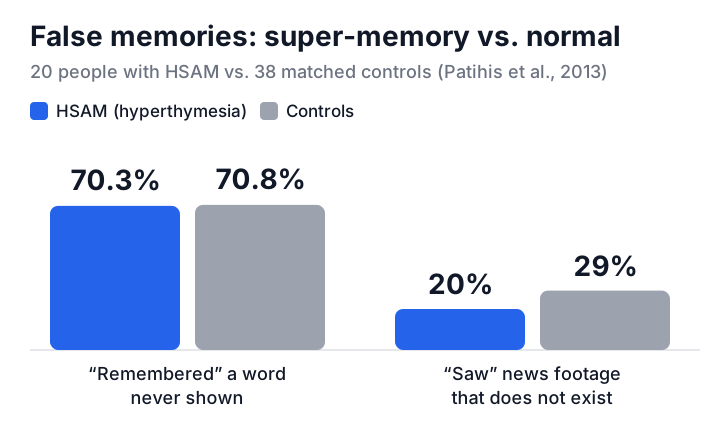
The most revealing finding came in 2013. Researchers gave 20 people with HSAM and 38 matched controls classic false-memory tasks. Shown lists of related words (such as bed, rest and tired), both groups falsely “remembered” a closely related word that was never on the list (such as sleep) at the same rate: 70.3% versus 70.8%. Asked about news footage of a plane crash that was never filmed, 20% of the HSAM group said they had seen it, against 29% of controls — a difference too small to be meaningful (Patihis et al., 2013).
What this tells us
Even the most extraordinary memories ever studied rebuild the past rather than replay it. If people who can recall every day of their lives still form false memories, a literal mental photograph is very unlikely to exist.
Does a photographic memory mean a high IQ?
No — and this is one of the clearest findings in the whole literature. Having a strikingly good memory and having a high IQ are largely separate things.
Start with eidetic imagery. After reviewing two decades of studies, Haber (1979) reported that research had “failed to demonstrate consistent correlates between the presence of eidetic imagery and any cognitive, intellectual, neurological, or emotional measure.” Children with eidetic images were not brighter, better readers, or better at abstract thinking.
Memory champions tell the same story. In 2003, Eleanor Maguire's team at University College London compared ten superior memorisers — most of them top World Memory Championship competitors — with ten matched controls. The memorisers' estimated IQ was 111; the controls' was 112. On a non-verbal reasoning test (Matrix Reasoning), the two groups were also close: 12.9 versus 12.4, where 10 is the population average.
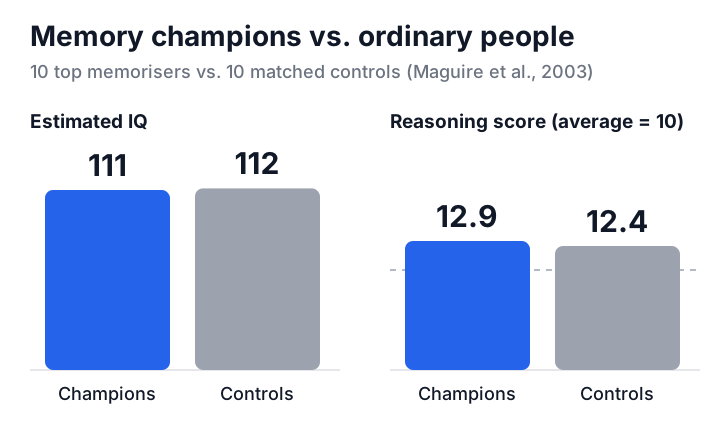
The authors' conclusion was blunt: superior memory “was not driven by exceptional intellectual ability or structural brain differences.” What set the champions apart was strategy — nine of the ten used the method of loci, which they had practised for an average of about 11 years.
Why the disconnect? IQ tests measure reasoning, verbal knowledge, spatial ability, processing speed and working memory together. Long-term memory for specific material is only a small part of that picture. A person can memorise pi to thousands of digits and still score near average, and a person with a very high IQ can be famously forgetful.
What IQ actually measures — The abilities behind an IQ score — and why memory is only one of them.Photographic memory, autism and ADHD
Extraordinary memory is often linked to autism, mainly because of savant syndrome. Psychiatrist Darold Treffert, who studied savants for decades, estimated that as many as one in ten autistic people show some remarkable ability, and that about half of all savants are autistic (Treffert, 2009). He also wrote that, whatever the savant skill, “it is always linked to massive memory.”
Two of the best-known examples are the artist Stephen Wiltshire, who drew a detailed panorama of Rome after a 45-minute helicopter ride, and Kim Peek, the man who inspired the film Rain Man and memorised thousands of books. But on the specific question of photographic memory, Treffert was careful: formal testing finds eidetic imagery “present in some, but certainly not all, savants,” and when present it “may exist more as a marker of brain damage than being central to savant abilities.”
Savant memory also tends to be narrow — dates, music, maps, buildings — rather than a general camera-like ability. And most autistic people are not savants. A 2015 study did find that autistic children had high-capacity, high-precision visual memory (Jiang et al., 2015), which runs against the old idea that visual memory is impaired in autism, but that is a single study of visual memory, not evidence of photographic memory.
For ADHD, the evidence is simpler: we found no peer-reviewed research linking ADHD to photographic or eidetic memory. Some people with ADHD describe remembering vivid details of things that interest them, which fits what is known about attention and interest boosting memory — but that is not the same thing.
Not a diagnosis
An unusual memory, good or poor, does not diagnose autism, ADHD or any other condition. Only a qualified professional using validated assessments can do that.
Famous people with a “photographic memory”: documented vs legend
Lists of famous people with photographic memories are everywhere — Nikola Tesla, Mozart, Leonardo da Vinci, Teddy Roosevelt. Almost none of these claims come from controlled testing. They come from biographies, anecdotes and retellings, which are exactly the sources memory research teaches us to doubt.
| Person | Claim | Evidence |
|---|---|---|
| “AJ” (Jill Price) | Remembers almost every day of her life | Documented — studied for years; the first published HSAM case (2006). Autobiographical, not photographic. |
| Stephen Wiltshire | Draws cityscapes from memory after one viewing | Documented savant ability (Treffert, 2009). Not shown to be eidetic; his drawings also include invented detail. |
| Kim Peek | Memorised thousands of books | Documented savant memory (Treffert, 2009). Narrow, fact-based recall. |
| World memory champions | Memorise cards, digits and names at record speed | Documented — and explained by trained technique (Maguire et al., 2003). |
| Nikola Tesla, Mozart, da Vinci | “Photographic memory” | Anecdotal. No controlled testing; treat as legend. |
The pattern is consistent: when a remarkable memory has been properly studied, it turns out to be narrow, technique-based or autobiographical — never a general-purpose camera.
What counts as a genius IQ? — Where “genius” sits on the IQ scale — and why famous-people claims are usually guesses.Can you train a photographic memory?
You cannot train a photographic memory, because there is no evidence one exists to be trained. But you can train a dramatically better memory — and the method is well tested.
The technique is the method of loci, also called the memory palace. You picture a place you know well, such as your home, and mentally “place” vivid images of the things you want to remember at points along a route through it. To recall them, you walk the route again in your mind. It works because human memory is very good at places and pictures, and much weaker at lists and abstract facts.
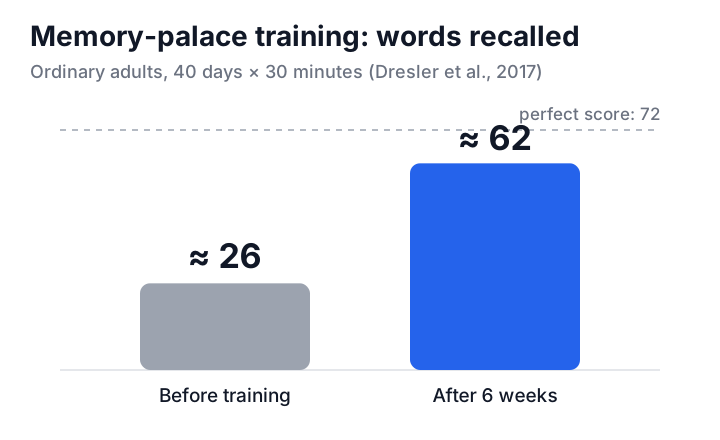
In a 2017 study published in Neuron, researchers trained ordinary adults with no memory experience for 40 days, 30 minutes a day. Their recall of a 72-word list rose from about 26 words to about 62, and four months later they were still well above where they started. Their brain connectivity patterns also shifted toward those of world-class memory athletes (Dresler et al., 2017).
- Choose a route you know well — your home, your street or your commute — and fix 10 stops along it.
- Turn each item to remember into a vivid, unusual image. Exaggeration and movement make it stick.
- Place one image at each stop, in order, and imagine interacting with it.
- Walk the route in your mind to recall the list. Then review it after an hour, a day and a week.
- Start with shopping lists or a short speech, then build up to longer material.
Two cautions. First, this is a skill for specific material — it will not raise your IQ or make you remember everything. Second, most memory games and apps train only the game itself; the gains rarely transfer to everyday memory or intelligence.
Do brain-training games work? — What the big studies found about apps that promise a sharper mind.Try it: a simple photographic memory self-check
There is no validated online test for eidetic or photographic memory, and any website that claims to diagnose one is overstating what it can do. But these three quick checks show the difference between a good memory and a camera-like one.
- The detail check. Look at a busy photograph for 30 seconds, then look away and answer specific questions: How many windows were there? What colour was the third car? Most people recall the gist well and the details poorly — which is normal.
- The backwards check. Read three lines of text, close your eyes and recite them backwards, word by word. A true mental photograph would make this as easy as reading forwards. For almost everyone, it is far harder.
- The position check. Look at a page for one minute, then try to name the fifth word on the seventh line. Remembering meaning is easy; remembering exact position is not.
What your result means
If these checks are hard, your memory is working exactly as human memory is designed to: it stores meaning and rebuilds detail. That is a strength, not a flaw — it is why you can recognise a friend in any light or from any angle.
Photographic memory: myths and facts
| Myth | Fact |
|---|---|
| Memory works like a video camera | Memory reconstructs events each time we recall them. Yet 63% of Americans believe the camera idea (Simons & Chabris, 2011). |
| Some adults have a true photographic memory | No adult case has been verified under controlled conditions; the famous 1970 case was never replicated. |
| Eidetic memory and photographic memory are the same | Eidetic imagery is a brief afterimage, mostly in children. Photographic memory, as usually described, has no evidence. |
| A great memory means a high IQ | Memory champions' IQs matched ordinary controls (111 vs 112), and eidetic imagery shows no link to intelligence. |
| People with perfect memory never misremember | People with HSAM form false memories as often as anyone (70.3% vs 70.8%). |
| You are born with a good memory or you are not | Six weeks of memory-palace training more than doubled ordinary adults' recall. |
| Memories are permanent once formed | 48% of Americans think so, but memories fade, change and can be altered by later information. |
The bottom line
Photographic memory, as a camera in the head, is a myth. Eidetic imagery is real but brief and mostly limited to children. Hyperthymesia is real but autobiographical, and it still rebuilds the past. Memory champions are real, and their secret is technique, not talent or IQ.
That is good news. The best memories ever studied were trained, which means a much better memory is within reach for almost anyone. And if you want to know where your reasoning, memory and other abilities really stand, a well-designed cognitive test will tell you more than any memory trick.
Take the free IQ test — 27 questions, about 12 minutes, with an instant score and a breakdown of your abilities.Frequently asked questions
Is photographic memory real?+
Not in the sense most people mean. No adult has been shown under controlled conditions to store a page or scene as an exact image and read details back later. What does exist is eidetic imagery (a brief visual afterimage, mostly in some children), hyperthymesia (near-total recall of one's own life), and trained memory skill such as the memory palace.
What is the difference between eidetic and photographic memory?+
Eidetic memory is a measured phenomenon: a vivid image that lingers for seconds to minutes after a picture is removed, found in a small minority of children and almost never in adults. Photographic memory is the popular idea of storing any page or scene permanently and exactly, and it is not supported by evidence.
How rare is eidetic memory?+
Rare in children and virtually nonexistent in adults. Haber's 1979 review described it as available only to a small percentage of children aged 6 to 12. Popular estimates of that percentage vary from about 2% to 15%, so no single figure should be taken as exact.
Does a photographic memory mean you have a high IQ?+
No. Research has found no consistent link between eidetic imagery and intelligence (Haber, 1979), and world memory champions had the same estimated IQ as matched controls — 111 versus 112 (Maguire et al., 2003). Their advantage came from technique, not intelligence.
Can you train yourself to have a photographic memory?+
You cannot train a photographic memory, but you can train a much better one. In a 2017 study, ordinary adults practising the memory-palace technique for 30 minutes a day over six weeks raised their recall from about 26 to about 62 words out of 72, and kept much of the gain four months later.
What is the difference between hyperthymesia and photographic memory?+
Hyperthymesia, or highly superior autobiographical memory (HSAM), is near-complete memory for the events of one's own life, often by date. It is real but extremely rare, applies only to personal experience, and people who have it still form false memories at normal rates. Photographic memory refers to exact images of anything seen, which has not been demonstrated.
Is photographic memory linked to autism or ADHD?+
Extraordinary memory is common in savant syndrome, and about half of savants are autistic, but eidetic imagery appears in only some savants and may reflect brain differences rather than cause their skill (Treffert, 2009). We found no peer-reviewed research linking ADHD to photographic or eidetic memory.
Is there a real test for photographic memory?+
There is no validated online test. Researchers have used laboratory methods such as picture-description tasks and random-dot stereograms. Simple self-checks — such as reciting a few lines of text backwards — show the difference between a good memory and a camera-like one, but they cannot diagnose anything.
Sources
This guide draws on standard psychometric references and peer-reviewed research:
- 1.Haber, R. N. (1979). “Twenty years of haunting eidetic imagery: Where's the ghost?” Behavioral and Brain Sciences, 2(4), 583–594.
- 2.Stromeyer, C. F., III, & Psotka, J. (1970). “The detailed texture of eidetic images.” Nature, 225, 346–349.
- 3.Merritt, J. O. (1979). “None in a million: Results of mass screening for eidetic ability using objective tests published in newspapers and magazines.” Behavioral and Brain Sciences, 2(4), 612.
- 4.Parker, E. S., Cahill, L., & McGaugh, J. L. (2006). “A case of unusual autobiographical remembering.” Neurocase, 12(1), 35–49.
- 5.LePort, A. K. R., et al. (2012). “Behavioral and neuroanatomical investigation of Highly Superior Autobiographical Memory (HSAM).” Neurobiology of Learning and Memory, 98(1), 78–92.
- 6.Patihis, L., et al. (2013). “False memories in highly superior autobiographical memory individuals.” Proceedings of the National Academy of Sciences, 110(52), 20947–20952.
- 7.Maguire, E. A., Valentine, E. R., Wilding, J. M., & Kapur, N. (2003). “Routes to remembering: the brains behind superior memory.” Nature Neuroscience, 6(1), 90–95.
- 8.Dresler, M., et al. (2017). “Mnemonic training reshapes brain networks to support superior memory.” Neuron, 93(5), 1227–1235.
- 9.Treffert, D. A. (2009). “The savant syndrome: an extraordinary condition. A synopsis: past, present, future.” Philosophical Transactions of the Royal Society B, 364(1522), 1351–1357.
- 10.Jiang, Y. V., Palm, B. E., DeBolt, M. C., & Goh, Y. S. (2015). “High-precision visual long-term memory in children with high-functioning autism.” Journal of Abnormal Psychology, 124(2), 447–456.
- 11.Simons, D. J., & Chabris, C. F. (2011). “What people believe about how memory works: A representative survey of the U.S. population.” PLoS ONE, 6(8), e22757.
- 12.Chase, W. G., & Simon, H. A. (1973). “Perception in chess.” Cognitive Psychology, 4(1), 55–81.
Sources are provided for further reading. Organization links point to official sites; academic works are cited in full. See our research standards and editorial team.
Find out your IQ
Take the free IQ test and get your score, percentile, and a full cognitive breakdown in about 12 minutes.
Start Free Test