Savant Syndrome: What It Is, How It Links to Autism and What IQ Misses
- Written by
- IQCognify Editorial Team
- Reviewed for accuracy
- IQCognify Research Review Process
- Last updated
- Reading time
- 14 min
Quick answer
Savant syndrome is a rare condition in which a person with a developmental disability, brain injury or brain disease has one or more areas of remarkable skill, such as music, art, memory or calendar calculation, that stand in sharp contrast to their overall difficulties. About half of known savants are autistic, and as many as one in ten autistic people show some savant ability. Most savants score below average on IQ tests, but not all: measured IQs range from well below 70 to 125 or higher.
What is savant syndrome?
Short answer
Savant syndrome is a rare condition in which someone with a developmental disability or a brain injury shows an exceptional skill in a narrow area, often music, art, memory, maths or calendar calculation. The skill is unexpected given the person's other difficulties, and it is almost always backed by an unusual memory.
The psychiatrist Darold Treffert described it as an "island of genius" against a background of disability (Treffert, 2009). Savant comes from the French savoir, "to know".
The British doctor John Langdon Down named it "idiot savant" in 1887, when "idiot" was a technical term for an IQ below 25. Because the label became offensive, Treffert proposed "savant syndrome" instead in 1988 (Treffert, 2014).
It is not a medical diagnosis and is not listed in the DSM-5. It describes a pattern of strengths on top of another condition, most often autism.
Types of savant syndrome
Treffert sorted savants in two ways: by how exceptional the skill is, and by how it appeared. He admitted the first scale is "subjective", but it is still the standard one.
By level of skill: splinter, talented and prodigious
| Level | What it looks like | How common |
|---|---|---|
| Splinter skills | Intense memory for narrow topics such as sports facts or birthdays or bus timetables or maps | The most common level |
| Talented savant | Music or art or another skill that stands out even compared with people without a disability | Less common |
| Prodigious savant | A skill so outstanding that in anyone else it would be called genius | Very rare: probably fewer than 100 known alive |
By how it appears: congenital, acquired and sudden
| Type | When skills appear | Underlying cause | Evidence |
|---|---|---|---|
| Congenital | Early childhood | Autism or another developmental condition | 287 of 319 registry cases |
| Acquired | After an injury or illness at any age | Head injury or stroke or dementia | 32 of 319 registry cases |
| Sudden | Suddenly in adulthood | No known cause or disability | 11 self-reported cases in one 2021 survey |
The registry figures come from Treffert & Rebedew (2015) and Treffert & Ries (2021). The "sudden savant" category is the newest and least certain: it rests on 11 people who filled in an online survey. Since they have no disability, the authors said "sudden genius" may be a better name.
What skills do savants have?
In the 2015 registry report, music was the most common main skill, with art and memory close behind at about one in five each. Calendar calculation, naming the weekday of any date, is famous but was the main skill in only 5% of congenital savants, though many have it as a second skill.
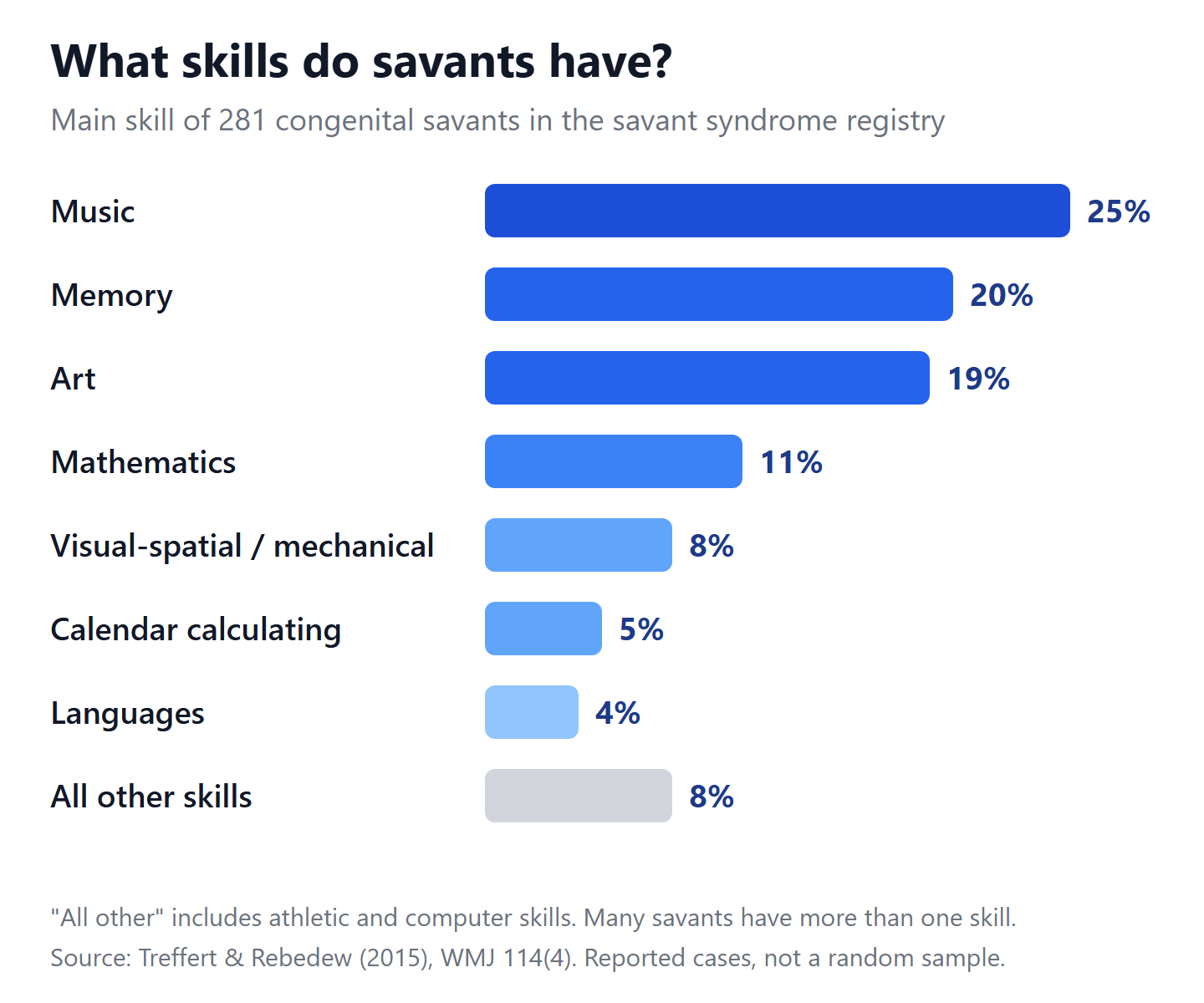
Whatever the skill, Treffert found it is "always linked to massive memory" (Treffert, 2009). And blind musical savants with an intellectual disability, such as Leslie Lemke and Derek Paravicini, are strikingly over-represented. Nobody knows why.
Savant memory is narrow and deep, not a general camera-like recall. Formal testing finds eidetic ("photographic") imagery in some savants but by no means all.
Is photographic memory real? — How savant memory differs from eidetic memory, hyperthymesia and memory champions.Savant syndrome and autism: how common is it?
Not all autistic people are savants, and not all savants are autistic. Treffert estimated that up to one in ten autistic people have some savant ability, and that about half of all savants are autistic. The other half have another developmental condition, a brain injury or a brain disease (Treffert, 2009).
The "one in ten" figure comes from a 1978 survey in which parents of 5,400 autistic children reported special abilities in 531 (Rimland, 1978). Studies using stricter or looser definitions produced very different numbers.
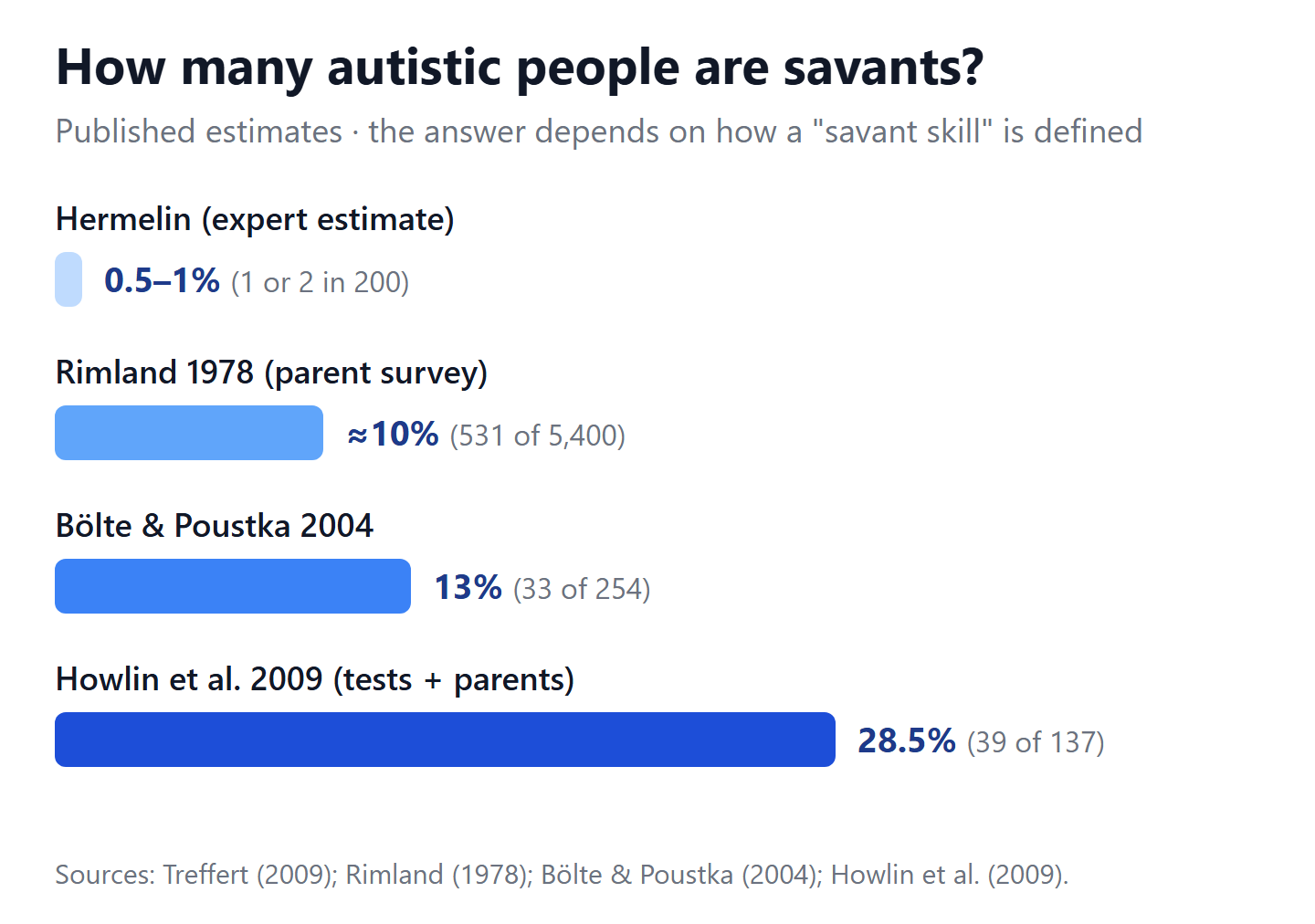
Savant skills are much rarer outside autism. A 1977 survey of institutions found about one savant per 2,000 residents with an intellectual disability, and a 2000 Finnish survey found about 1.4 per 1,000 (Treffert, 2009). We could not trace the "one in a million" figure seen on many websites to any study.
Savants are more often male: about six to one in Treffert's 2009 review and four to one in his later registry. In that registry 75% of congenital savants were autistic, but it collects cases sent in by families and clinicians, so it is not a population sample (Treffert & Rebedew, 2015).
Not a diagnosis
A remarkable memory or talent does not mean a person is autistic or a savant, and an unusual skill profile is not a reason to assume a disability. Only a qualified professional using validated assessments can diagnose autism or any other condition.
Savant syndrome and IQ
Most savants score below average on IQ tests, but low IQ is not part of the definition. Treffert wrote that most savants tested have IQs between 50 and 70, but "in some instances IQ can be as high as 125, or even higher" (Treffert, 2014). Almost all cases occur in people with an IQ above 40 (Treffert, 2009).
Howlin and colleagues tested 137 autistic people (average age 24) and found that no one with a non-verbal IQ below 50 had a savant skill (Howlin et al., 2009). Some underlying reasoning ability seems to be needed.
Two documented scores show how little the number says. Leslie Lemke, a blind musical savant, scored 58 on the WAIS-R using verbal tests only, because the performance tests rely on sight (Treffert, 2014). Kim Peek scored 87 overall in 1988, and his assessors wrote that the score was "not a valid description of his intellectual ability" (Treffert & Christensen, 2005). For other famous savants, such as Stephen Wiltshire, Daniel Tammet or Derek Paravicini, we found no published IQ score, so we do not give one.
Why IQ tests miss what savants can do
Treffert gave three reasons. IQ tests lean heavily on language, which many savants find hard. IQ captures only one kind of ability, so an extraordinary skill in another area barely registers. And communication or behaviour can make people hard to test accurately (Treffert, 2014).
Despite Lemke's score of 58, a 1989 study comparing his piano improvisations with a professional musician's found the difference lay in musical preference and personality rather than musicianship (Hermelin et al., 1989). Howard Gardner used savants as evidence for multiple intelligences, though support for that theory remains limited.
Gardner's multiple intelligences — What the theory claims, how it differs from IQ, and what the evidence shows.Savant, prodigy, gifted: what is the difference?
| Term | Skill pattern | Underlying disability | Typical IQ |
|---|---|---|---|
| Savant | One or a few islands of exceptional skill | Yes (developmental or acquired) | Usually below average but varies widely |
| Prodigy | Adult-level skill in childhood | No | Usually high across the board |
| Gifted | High general ability | No | Often 130 or above on a full-scale test |
Famous people with savant syndrome
These are some of the best-documented savants. Every fact below comes from a published source.
| Person | Main skill | Type | Documented facts |
|---|---|---|---|
| Thomas "Blind Tom" Wiggins Bethune (19th century) | Piano | Congenital | Blind; first public concert at 8; repertoire of thousands of pieces |
| Leslie Lemke | Piano | Congenital | Blind; played Tchaikovsky's First Piano Concerto at 14 after one hearing |
| Kim Peek (1951 to 2009) | Memory | Congenital | Born without a corpus callosum; learned about 9000 books by heart |
| Stephen Wiltshire (born 1974) | Drawing | Congenital | Autistic; draws detailed city panoramas from memory after short helicopter flights; MBE 2006 |
| Derek Paravicini (born 1979) | Piano | Congenital | Born at 25 weeks; blind; severe learning disability; absolute pitch |
| Daniel Tammet (born 1979) | Numbers and languages | Congenital | Recited pi to 22514 decimal places in 2004; studied for synaesthesia and Asperger syndrome |
| Jason Padgett | Geometric drawing | Acquired | Reports new abilities after a 2002 head injury; studied with brain imaging in 2013 |
Kim Peek, the real Rain Man
Kim Peek inspired the 1988 film Rain Man. He read a page in eight to ten seconds and had learned about 9,000 books by heart by 2005; the often-quoted 12,000 is a later, less certain figure. His recorded diagnosis was a developmental disorder "with no diagnosis of autistic disorder", and the film's story is fictional (Treffert & Christensen, 2005).
What the other cases show
Stephen Wiltshire, appointed MBE in 2006 for services to art, has kept and developed his skill into adulthood, and Leslie Lemke moved from copying music to improvising (Treffert, 2014), against the old idea that savants only copy. Cambridge researchers reported that Daniel Tammet, who recited pi from memory at Oxford in 2004 (Tammet, 2006), has synaesthesia (he experiences numbers as colours and shapes) and Asperger syndrome (Bor et al., 2007). Jason Padgett's account of his 2002 injury is his own; a 2013 brain-imaging study found that formulas which trigger his geometric images activated areas only in the left hemisphere (Brogaard et al., 2013).
What causes savant syndrome?
No single theory explains all savants, as Treffert himself said (Treffert, 2009). The table grades the main ideas by the strength of their evidence.
| Theory | The idea | Evidence |
|---|---|---|
| Brain injury with compensation | Damage often in the left hemisphere releases skills elsewhere | Supported by acquired cases such as dementia patients who began to paint |
| Detail-focused processing | Attention to parts over the whole (weak central coherence) | Good evidence in autism; does not explain non-autistic savants |
| Enhanced perception | Sharper low-level perception of sounds and patterns | Good evidence in autism; links to perfect pitch |
| Hyper-systemising | A strong drive to find rules in systems such as calendars | Supported by studies of autistic talent |
| Privileged access | Savants reach raw information most brains filter out | Small brain-stimulation studies; limited replication |
| Practice and memory | Intense interest and repetition build skill | Likely part of the story but not the whole |
| Genetic memory | Treffert's idea that some knowledge is inherited | Speculative; no direct evidence |
The left-hemisphere and acquired-savant evidence
From 1996, neurologist Bruce Miller and colleagues described people with frontotemporal dementia who developed new artistic skill; brain scans pointed to dysfunction at the front of the left temporal lobe (Miller et al., 1996; Treffert, 2014). Treffert linked this to Narinder Kapur's idea of "paradoxical functional facilitation": damage in one area releases abilities in another that it normally holds back (Kapur, 1996). This concerns specific damage, not "left-brained" or "right-brained" people, which is a myth.
Left brain vs right brain — Why the idea of left-brained and right-brained people does not hold up.Can brain stimulation create savant skills?
Not reliably. Allan Snyder's team in Sydney used magnetic stimulation (rTMS) to briefly dampen the left fronto-temporal area in 11 students; four changed their drawing style and some proofread better (Snyder et al., 2003). Snyder argues savants have "privileged access" to raw information other brains filter out (Snyder, 2009). The studies are small, the effects modest and temporary, and replication is limited.
Autism research adds another piece. Many autistic people process detail and perceive patterns unusually well, which may give some a head start on savant skills (Happé & Vital, 2009; Mottron et al., 2006; Baron-Cohen et al., 2009). That helps explain why savant skills are more common in autism, but not the half of savants who are not autistic.
Savant syndrome myths and facts
| Myth | Fact |
|---|---|
| All autistic people are savants | Most are not. Estimates range from under 1% to 28.5% depending on the definition |
| All savants are autistic | About half are. The rest have other developmental conditions or brain injuries |
| Savants always have a low IQ | Most tested score 50 to 70 but some score 125 or higher |
| Kim Peek was autistic | His recorded diagnosis was a developmental disorder with no autism diagnosis |
| Savants only copy and are not creative | Treffert found many move from copying to improvising to creating |
| Savant skills fade if the person learns other skills | Usually not. Skills tend to persist and grow; loss as in the case of Nadia is rare |
| Savant syndrome affects 1 in a million people | We could not trace this figure to any study |
Is there a test for savant syndrome?
No. There is no validated savant syndrome test, online or clinical. It is recognised by describing a person's skills alongside an underlying condition that a doctor or psychologist assesses. Online "hidden savant" quizzes are entertainment, not assessment.
If you are concerned about a child's development, or about a sudden change in an adult's abilities after an injury or illness, see a qualified professional. A new skill in later life can, rarely, accompany a brain condition such as dementia.
An IQ test measures something different: general reasoning across several areas. It will not detect a savant skill, but it can show your overall pattern of strengths.
What IQ counts as genius? — Where "genius" sits on the IQ scale, and why famous-people claims are usually guesses.Take the free IQ test — 27 questions, about 12 minutes, with an instant score and a breakdown of your abilities.Sources
- Treffert, D. A. (2009). The savant syndrome: an extraordinary condition. A synopsis: past, present, future. Philosophical Transactions of the Royal Society B, 364(1522), 1351–1357. https://doi.org/10.1098/rstb.2008.0326
- Treffert, D. A. (2014). Savant syndrome: realities, myths and misconceptions. Journal of Autism and Developmental Disorders, 44(3), 564–571. https://doi.org/10.1007/s10803-013-1906-8
- Treffert, D. A., & Rebedew, D. L. (2015). The savant syndrome registry: a preliminary report. WMJ, 114(4), 158–162. https://wmjonline.org/wp-content/uploads/2015/114/4/158.pdf
- Treffert, D. A., & Ries, H. J. (2021). The sudden savant: a new form of extraordinary abilities. WMJ, 120(1), 69–73. https://wmjonline.org/wp-content/uploads/2021/120/1/69.pdf
- Treffert, D. A., & Christensen, D. D. (2005). Inside the mind of a savant. Scientific American, 293(6), 108–113. https://www.scientificamerican.com/article/inside-the-mind-of-a-sava/
- Rimland, B. (1978). Savant characteristics of autistic children and their cognitive implications. In G. Serban (Ed.), Cognitive Defects in the Development of Mental Illness. New York: Brunner/Mazel.
- Bölte, S., & Poustka, F. (2004). Comparing the intelligence profiles of savant and nonsavant individuals with autistic disorder. Intelligence, 32(2), 121–131. https://doi.org/10.1016/j.intell.2003.11.002
- Howlin, P., Goode, S., Hutton, J., & Rutter, M. (2009). Savant skills in autism: psychometric approaches and parental reports. Philosophical Transactions of the Royal Society B, 364(1522), 1359–1367. https://doi.org/10.1098/rstb.2008.0328
- Hermelin, B., O'Connor, N., Lee, S., & Treffert, D. A. (1989). Intelligence and musical improvisation. Psychological Medicine, 19(2), 447–457. https://doi.org/10.1017/S0033291700012484
- Happé, F., & Vital, P. (2009). What aspects of autism predispose to talent? Philosophical Transactions of the Royal Society B, 364(1522), 1369–1375. https://doi.org/10.1098/rstb.2008.0332
- Baron-Cohen, S., Ashwin, E., Ashwin, C., Tavassoli, T., & Chakrabarti, B. (2009). Talent in autism: hyper-systemizing, hyper-attention to detail and sensory hypersensitivity. Philosophical Transactions of the Royal Society B, 364(1522), 1377–1383. https://doi.org/10.1098/rstb.2008.0337
- Snyder, A. (2009). Explaining and inducing savant skills: privileged access to lower level, less-processed information. Philosophical Transactions of the Royal Society B, 364(1522), 1399–1405. https://doi.org/10.1098/rstb.2008.0290
- Snyder, A. W., Mulcahy, E., Taylor, J. L., Mitchell, D. J., Sachdev, P., & Gandevia, S. C. (2003). Savant-like skills exposed in normal people by suppressing the left fronto-temporal lobe. Journal of Integrative Neuroscience, 2(2), 149–158. https://doi.org/10.1142/S0219635203000287
- Mottron, L., Dawson, M., Soulières, I., Hubert, B., & Burack, J. (2006). Enhanced perceptual functioning in autism: an update, and eight principles of autistic perception. Journal of Autism and Developmental Disorders, 36(1), 27–43. https://doi.org/10.1007/s10803-005-0040-7
- Bor, D., Billington, J., & Baron-Cohen, S. (2007). Savant memory for digits in a case of synaesthesia and Asperger syndrome is related to hyperactivity in the lateral prefrontal cortex. Neurocase, 13(5), 311–319. https://doi.org/10.1080/13554790701844945
- Tammet, D. (2006). Born on a Blue Day: A Memoir of Asperger's and an Extraordinary Mind. London: Hodder & Stoughton.
- Brogaard, B., Vanni, S., & Silvanto, J. (2013). Seeing mathematics: perceptual experience and brain activity in acquired synesthesia. Neurocase, 19(6), 566–575. https://doi.org/10.1080/13554794.2012.701646
- Miller, B. L., Ponton, M., Benson, D. F., Cummings, J. L., & Mena, I. (1996). Enhanced artistic creativity with temporal lobe degeneration. The Lancet, 348(9043), 1744–1745. https://doi.org/10.1016/S0140-6736(05)65881-3
- Kapur, N. (1996). Paradoxical functional facilitation in brain-behaviour research: a critical review. Brain, 119(5), 1775–1790. https://doi.org/10.1093/brain/119.5.1775
- Ockelford, A. (2007). In the Key of Genius: The Extraordinary Life of Derek Paravicini. London: Hutchinson.
- Stephen Wiltshire Gallery. Biography. https://www.stephenwiltshire.co.uk/biography
Frequently asked questions
What is savant syndrome in simple terms?+
A person with a developmental disability or brain injury has an exceptional skill in one narrow area, such as music, art, memory, maths or calendar calculation, that stands out sharply against their other difficulties.
Is savant syndrome a form of autism?+
No, though the two often occur together. About half of known savants are autistic, and up to one in ten autistic people show some savant ability. Other savants have different developmental conditions or brain injuries.
What is the IQ of a savant?+
There is no typical savant IQ. Most savants tested score between 50 and 70, but some score 125 or higher. Leslie Lemke scored 58 on verbal tests and Kim Peek 87 overall; in both cases the number badly understated their skills.
How rare is savant syndrome?+
Studies of autistic people range from under 1% to 28.5%, with 10% the most quoted figure. Outside autism it is much rarer, around 1 in 1,000 to 1 in 2,000 people with an intellectual disability. There are probably fewer than 100 prodigious savants alive.
What is acquired savant syndrome?+
It is when savant skills appear for the first time after a brain injury, stroke, dementia or other brain disease. It is much rarer than the congenital form: 32 of the 319 savants in Treffert's registry were acquired cases.
Can you become a savant?+
Not by choice. Acquired savant skills have followed brain injury or illness, and small brain-stimulation studies produced only modest, temporary changes. Practice can build impressive memory, but that is training, not savant syndrome.
Was Kim Peek autistic?+
No. Kim Peek, the inspiration for Rain Man, had a recorded diagnosis of a developmental disorder with no diagnosis of autistic disorder. He was born without a corpus callosum, the band of fibres linking the two halves of the brain.
Is there a test for savant syndrome?+
No validated test exists. A qualified professional assesses the underlying condition and describes the exceptional skill alongside it. Online savant quizzes are not diagnostic, and an IQ test will not detect a savant skill.
Find out your IQ
Take the free IQ test and get your score, percentile, and a full cognitive breakdown in about 12 minutes.
Start Free Test